The Creation, Craft, and Controversy of the Bayeux Tapestry
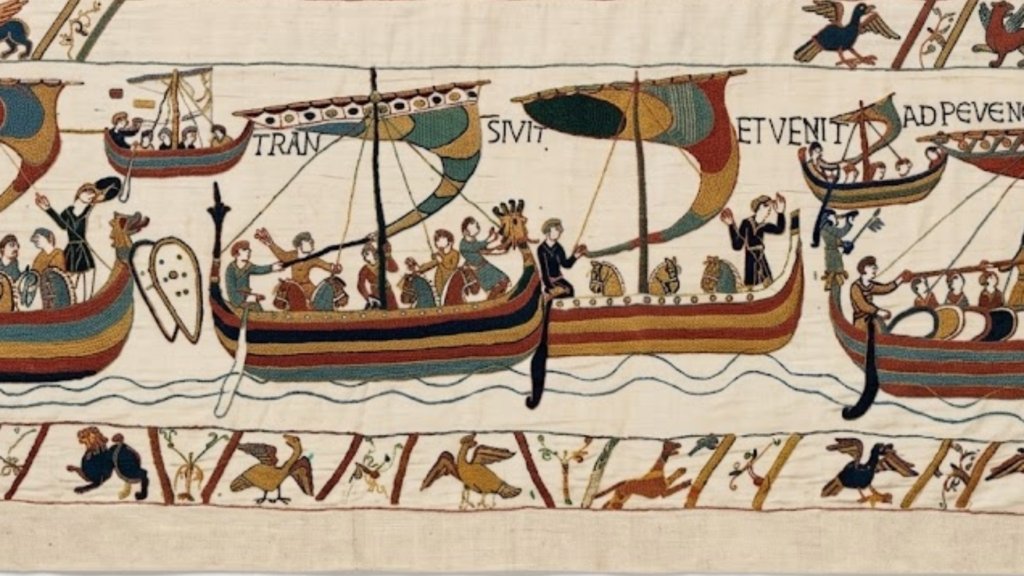
The year 1066 is permanently etched into the bedrock of Western history. In a single, blood-soaked afternoon at the Battle of Hastings, the Anglo-Saxon ruling class was obliterated, and Duke William of Normandy seized the crown of England. Yet, the conquest could not be maintained by swords alone. William needed to legitimise his violent coup in the eyes of God and Europe.
The ultimate weapon in this 11th-century public relations war was not made of iron or stone. It was made of linen and wool.
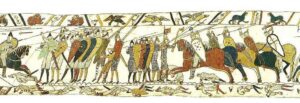
Measuring nearly 70 meters long and 50 centimetres high, the Bayeux Tapestry is a monumental masterpiece of medieval storytelling. But how exactly did this staggering piece of political art come into existence? To truly understand its genius, we have to look past the battlefield narrative and examine the raw materials, the anonymous hands, and the profound historical significance stitched into its fibres.
What is it Made Of?
Before diving into the history, we must address a technical truth: the Bayeux Tapestry is a misnomer. A true tapestry has its designs woven directly into the fabric on a loom. The Bayeux masterpiece is actually an embroidery.
The canvas consists of nine separate panels of high-quality, bleached linen, which were stitched together after the embroidery was completed to form one continuous narrative scroll.
The vibrant images themselves were created using crewel wool yarn. The medieval artisans relied on a remarkably limited palette of just four primary colours, extracted from native plants:
- Blue-Green: Sourced from woad.
- Red-Brown: Sourced from madder.
- Yellow: Sourced from weld.
- Terracotta and Black: Used for outlines and deep contrasts.
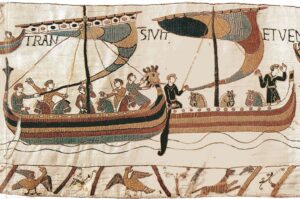
Through varying shades and clever colour-blocking, the creators managed to depict 626 people, 202 horses, 55 dogs, 505 mythological creatures, 37 buildings, and 41 ships using nothing more than vegetable-dyed sheep’s wool.
When and Why Was It Made?
The tapestry was commissioned in the immediate aftermath of the Conquest, likely between 1070 and 1077. Historians widely believe it was completed in time to be displayed at the dedication of the magnificent new Bayeux Cathedral in 1077.
The mastermind behind the project was Bishop Odo of Bayeux, William the Conqueror’s fiercely ambitious half-brother. Odo had fought at Hastings himself, swinging a heavy wooden mace because Christian clergy were technically forbidden from shedding blood with edged weapons.
Odo’s motivations were twofold:
- Norman Propaganda: The tapestry was explicitly designed to justify the invasion. The narrative carefully frames King Harold II as a tragic usurper who broke a sacred holy oath to William, thereby casting the Norman invasion not as a greedy land grab, but as a righteous act of divine justice.
- Self-aggrandisement: Bishop Odo ensured he was prominently featured in the narrative, securing his own legacy right alongside the Conqueror.
Who Made It?
While a Norman warlord paid the bills, the actual hands that held the needles belonged to the conquered.
For centuries, French tradition claimed that William’s wife, Queen Matilda, made the tapestry with her ladies-in-waiting. However, modern historical consensus has shattered this romantic myth. The artistic style, the specific spelling of English names in the Latin inscriptions, and the quality of the needlework point directly to Anglo-Saxon embroiderers.
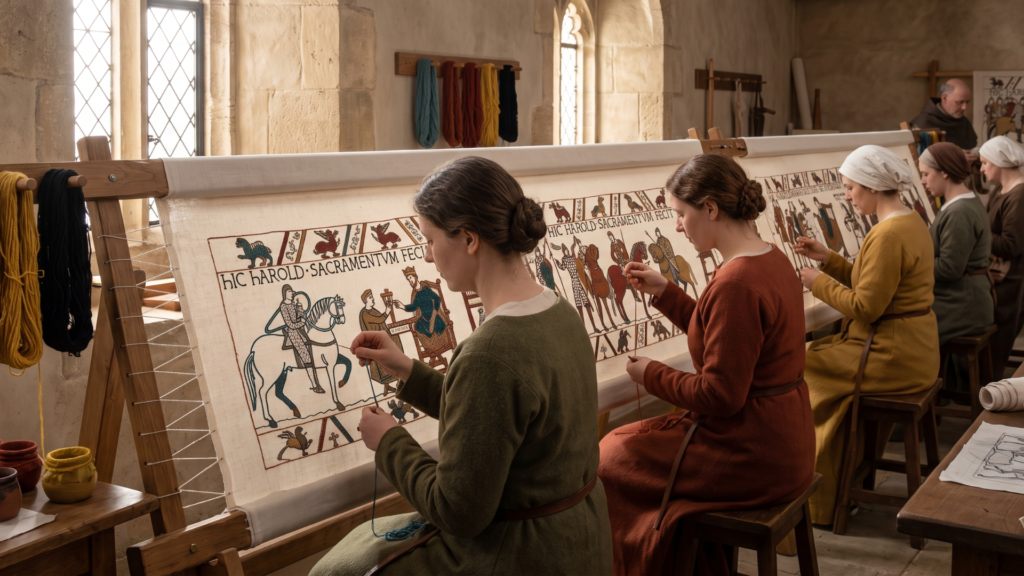
Specifically, the tapestry was almost certainly produced in Canterbury, Kent. During the 11th century, England was famous throughout Europe for its unrivaled textile artists—a style of luxury embroidery known as Opus Anglicanum. The tragic irony of the Bayeux Tapestry is that English women were forced to spend years meticulously illustrating the violent destruction of their own kingdom for their new French-speaking masters.
How Was It Made?
The creation of the tapestry was a massive logistical undertaking that required a strict division of labor:
The Master Design
First, a master artist—likely a monk trained in manuscript illumination—sketched the entire 70-meter layout onto the blank linen panels using charcoal or ink. They left precise gaps for the text and planned the complex borders.
The Stitching Process
Once the outlines were drawn, the embroiderers went to work using just two primary stitches:
The Stem Stitch: Used exclusively for outlining the figures, facial features, and lettering.
- Laid-and-Couched Work (The “Bayeux Stitch”): This technique was used to fill in solid blocks of color. Long strands of wool were “laid” across the fabric, and then tiny, delicate cross-stitches were sewn down to “couch” or anchor the wool securely to the linen. This created a raised, richly textured surface that made the figures pop off the canvas.
The historical value of the Bayeux Tapestry cannot be overstated. Because we have very few surviving secular textiles from the early Middle Ages, it serves as an invaluable visual encyclopaedia of 11th-century life.
Without it, our understanding of medieval material culture would be deeply impoverished. It provides historians with definitive, contemporaneous evidence of:
- Military Technology: The exact design of chainmail hauberks, kite shields, nasal helmets, and the mechanics of early Norman cavalry warfare.
- Architecture: The rapid construction of prefabricated wooden motte-and-bailey castles.
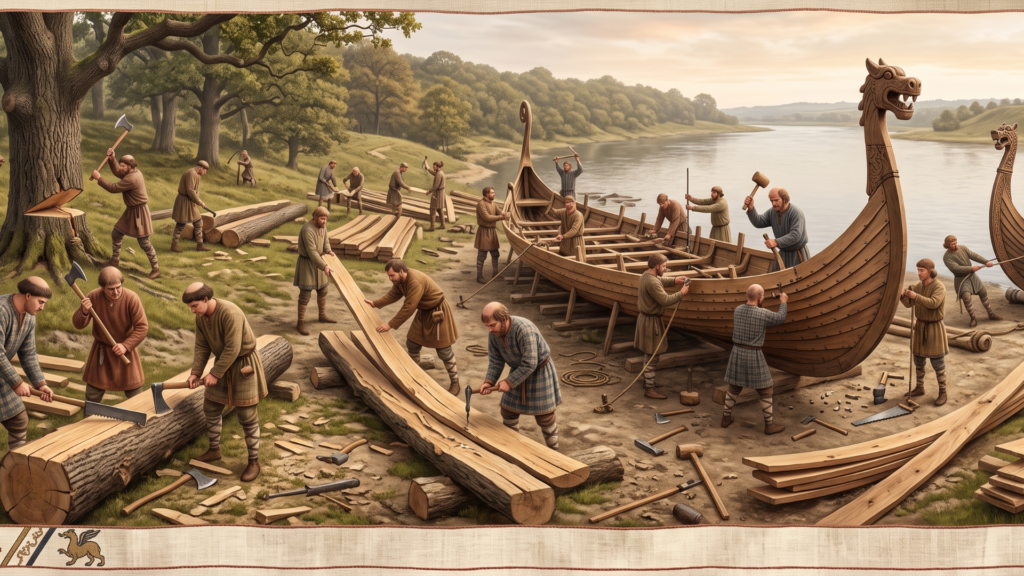
- Everyday Life: 11th-century shipbuilding techniques, agricultural tools, cooking over open pits, and even the distinct hairstyles of the era (the Normans shaved the backs of their heads, while the English wore long moustaches).
A Shared Heritage: Why It Matters to Both Nations
Today, the Bayeux Tapestry is a unique cultural bridge, holding profound emotional and historical weight for both the English and the French.
For the French:
It is a monument to a moment of supreme audacity. It marks the birth of the Anglo-Norman empire, a time when a duchy from northern France fundamentally altered the geopolitical trajectory of the British Isles and Europe. It is celebrated as a triumph of Norman determination and continental influence.
For the English:
It is the ultimate document of their nation’s foundational tragedy. Yet, it is also a source of immense cultural pride. It stands as an enduring monument to the sophistication, resilience, and artistry of the Anglo-Saxon people. Even in total military defeat, English artistic excellence captured the imagination of the world. Nearly a thousand years later, the linen has yellowed and the wool has faded, but the human drama stitched into the Bayeux Tapestry remains as vibrant, raw, and captivating as the day it left the needles of Canterbury