
The Grand Spectacle of Mathilda's Feast
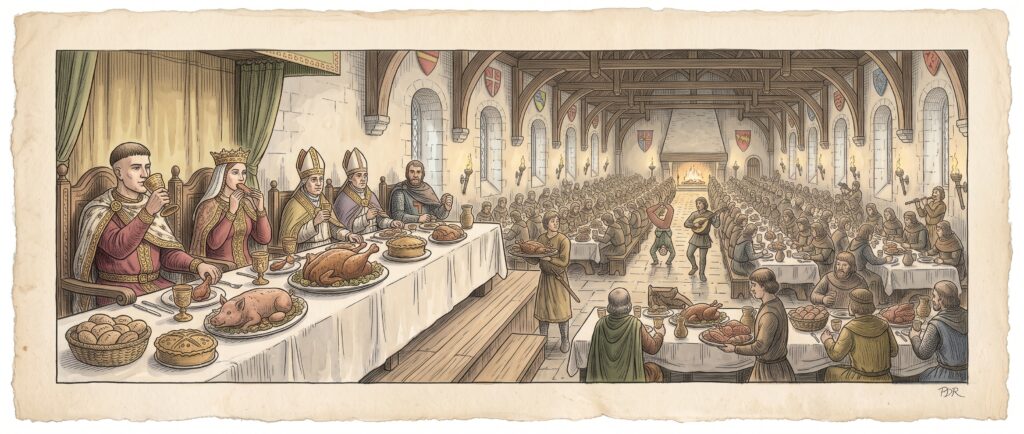
On Whit Sunday, May 11, 1068, Winchester Castle hosted one of the most significant political spectacles of the early Middle Ages: the post-coronation feast of Queen Matilda of Flanders. Having been crowned in Winchester Cathedral by Ealdred, Archbishop of York, Matilda’s seating as Queen of England was not merely a royal celebration—it was a calculated display of Norman legitimacy, territorial dominance, and raw power.
To cement William the Conqueror’s new realm, the royal household staged a grand feast for over 1,000 attendees, ranging from senior Norman dukes and bishops to surviving Anglo-Saxon thanes, foreign envoys, and tactical retainers. Executing a banquet of this magnitude without modern equipment required military-grade logistics, strict ceremonial protocols, and a kitchen operation working at absolute capacity.
Behind the Scenes: Mass Preparation & Kitchen Logistics
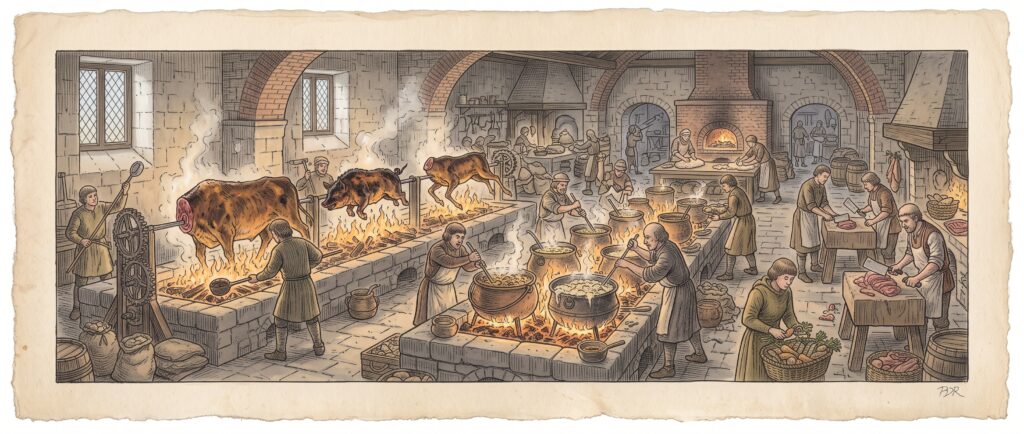
Feeding 1,000 guests in the 11th century required months of advance requisitioning across the English shires. Because fresh meat spoiled rapidly, hundreds of live animals were driven to Winchester in the days leading up to Whitsun and slaughtered on-site. The master of the kitchen (Le Queux), overseen by King William’s household officers, managed a staggering supply list:
- 3,000 loaves of coarse rye and barley bread (used primarily as trenchers, or edible plates) alongside fine white wheat bread (manchet) reserved for the High Table.
- 25 whole oxen, 40 pigs, 10 wild boars, and 60 sheep, supplemented by over 1,500 game birds (swans, peacocks, capons, and geese).
- 2,000 smoked or pickled river eels and herring to accommodate clergy observing dietary fasts.
- 1,800 gallons of ale, cider, and Gascon red wine, heavily infused with luxury imported spices.
Winchester’s permanent stone kitchens could not process this volume. The solution was modular infrastructure: temporary timber outbuildings were erected in the outer courtyard to isolate smoke and fire hazards. Outside, servants dug 30-foot shallow trenches filled with hardwood charcoal. Iron spits loaded with whole carcasses were suspended above the trenches, turned continuously for hours by kitchen boys (scullions) who basted the meats with lard, cider, and herb glazes using long brush-tipped sticks.
In the temporary kitchens, massive 50-gallon iron cauldrons simmered over pit fires, reducing bones into thick gelatinous stocks for pottages and sauces.
The Running Order of the Day: From Sacred Anointing to Evening Revelry
The feast followed a rigid timeline designed to blend religious reverence with secular authority:
06:00 AM ── Kitchen fires lit; butchery begins; wine barrels tapped and inspected.
09:00 AM ── Coronation Mass in Winchester Cathedral; Archbishop Ealdred crowns Matilda.
11:30 AM ── Royal Procession into the Great Hall, heralded by brass trumpets.
12:00 PM ── The Ceremonial Handwashing (“The Laving”) with rosewater pitchers.
12:30 PM ── First Service: Pottage, smoked fish, and symbolic roasts presented.
02:00 PM ── Second Service: Heavy game roasts; The Champion’s Challenge ritual.
04:00 PM ── Third Service: Poached fruits, aged cheeses, and warm spiced wines.
06:00 PM ── Distribution of Alms (leftovers given to the poor at the gates).
08:00 PM ── Royal party retires; informal drinking continues among the knights.
The Highlights of the Pageant
- The Laving (12:00 PM): Before touching food, the King, Queen, and high nobility participated in a public handwashing ritual. Ewerers circulated with silver pitchers of warm water infused with rose petals and sage, offering fine linen towels. In an era where food was eaten with daggers and fingers, this was both essential hygiene and courtly theatre.
- The Champion’s Challenge (02:30 PM): During the Second Service, a fully armoured Norman knight rode a warhorse directly into the centre of the Great Hall. A herald proclaimed that if anyone dared deny Queen Matilda’s right to rule England, the champion would fight them to the death on the spot. (No one stepped forward).
Entertainment Throughout: Between courses, acrobats, jongleurs, and minstrels performed songs of conquest (chansons de geste), accompanied by harps and pipes.
The Mass Coronation Menu & Recipes (Scaled for 1,000 Diners)
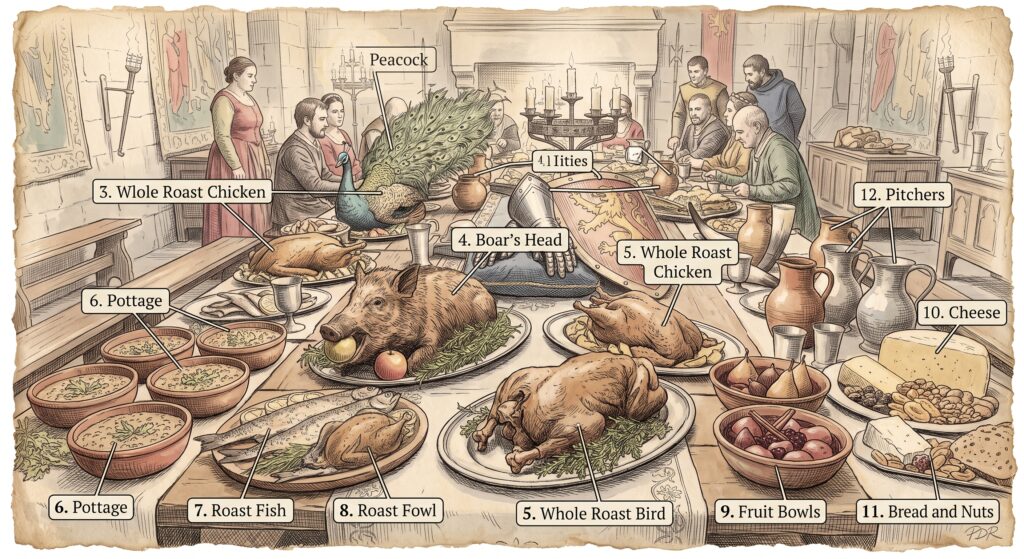
Because written menus did not exist in 1068, food was presented processionally in three distinct “services.” Each course was heralded by a blast of trumpets (buccinas). A high official called the Sewer led a procession of carvers into the hall, while heralds loudly proclaimed each dish to the tables: “Behold the wild boar of the New Forest, dressed with sage and red wine!”
Here is how the master cooks prepared the coronation dishes at full scale for 1,000 guests.
1. Grand Pottage de Poireaux et d’Avoine (First Service)
A thick grain and vegetable pottage designed to coat the stomach and showcase rich meat broths across four 50-gallon copper cauldrons.
- Prep time: 3 hours | Cook time: 4 hours | Serves: 1,000
- Ingredients:
- 200 lbs coarse steel-cut oats and barley
- 400 lbs leeks and yellow onions, washed and chopped
- 150 lbs beef marrow bones and pork fat
- 150 gallons water and light ale broth
- 50 lbs soft goat’s curd or fresh ricotta
- 5 lbs fresh parsley, sage, and thyme
- 10 lbs coarse sea salt and cracked black pepper
Preparation:
- Fire up four 50-gallon copper cauldrons over outdoor charcoal pit fires. Add 150 lbs of beef marrow bones, pork fat, and 150 gallons of water/ale broth. Boil for 2 hours to render a deep, rich stock, then scoop out the spent bones.
- Dump in 400 lbs of chopped leeks and onions, cooking them down into the boiling broth until softened.
- Gradually stir in 200 lbs of steel-cut oats and barley using large wooden oars. Simmer for 1.5 to 2 hours, stirring continuously to prevent scorching, until the grains swell and thicken the broth into a heavy porridge.
- Stir in 5 lbs of chopped fresh herbs and 10 lbs of salt and pepper.
- Ladle into wooden trenchers or bowls, topping each serving with a crumble of soft goat’s curd just before the servers carry them into the hall.
2. Grand Rôti de Venaison au Vin Rouge (Second Service)
Venison was the premier status meat of Norman royalty. This required a massive outdoor spit-roast operation utilizing 35 full legs of venison.
- Prep time: 24 hours (marinating) | Cook time: 3 to 4 hours | Serves: 1,000
- Ingredients:
- 35 bone-in legs of venison (approx. 1200 lbs of meat total)
- 60 gallons dark Gascon red wine
- 5 gallons cider vinegar
- 40 lbs lard or clarified butter
- 10 lbs chopped fresh sage and rosemary
- 3 lbs ground ginger
- 3 lbs ground black pepper
- 10 lbs coarse sea salt
Preparation:
- The Mass Marinade: In six large wooden curing tuns, combine 60 gallons of red wine, 5 gallons of cider vinegar, ground ginger, and black pepper. Submerge the venison legs, cover with linen cloths, and steep overnight.
- The Fire Trenches: At dawn, dig two 30-foot open fire trenches in the courtyard and fill them with hardwood charcoal embers.
- Pre-Cook & Sear: Remove venison from marinade, pat dry, and rub all carcasses with lard, salt, chopped sage, and rosemary. Skewer the legs onto long iron spits mounted above the charcoal trenches.
- Roasting: Station scullion boys at each spit end to turn the meat continuously for 3 to 4 hours. Baste every 15 minutes using long-handled brooms dipped into the reserved wine marinade mixed with pan drippings.
- Serving: Once internal temperatures reach medium-rare, carvers slice the meat directly off the spits onto wooden platters for immediate delivery to the tables.
3. Poires au Miel et Gingembre (Third Service)
Poached pears served at mass scale using giant cauldrons and raw honey gathered from royal manors.
- Prep time: 2 hours | Cook time: 1 hour | Serves: 1,000
- Ingredients:
- 1,200 firm cooking pears (Bosc or Concorde)
- 50 gallons sweet white wine or hard pear cider
- 150 lbs raw wild honey
- 10 lbs fresh ginger knob, sliced
- 2 lbs whole cinnamon sticks / cassia bark
- 1 lb whole cloves
Preparation:
- In two 50-gallon cauldrons, combine 50 gallons of white wine, 150 lbs of raw honey, sliced ginger, cinnamon sticks, and cloves enclosed in cheesecloth bags. Bring to a boil over medium pit fires until the honey is fully integrated into a golden syrup.
- Carefully dump in 1,200 peeled pears (trimmed at the base).
- Lower the fire and gently simmer the pears in the syrup for 25–30 minutes until tender and translucent.
- Using large slotted wooden spoons, scoop out the pears and arrange them on wide serving platters.
- Keep the cauldrons boiling on high heat for another 15 minutes to reduce the remaining wine and honey into a thick, shiny glaze. Strain out the spice bags and pour the piping-hot honey syrup over the plated pears.
4. Hypocras for the Court (Spiced Banquet Wine)
Served to the entire hall at the end of the feast to aid digestion.
In ten 30-gallon wooden oak tuns, combine 300 gallons of red wine, 100 lbs of raw honey, 10 lbs ground cinnamon, 3 lbs ground ginger, and 2 lbs ground nutmeg. Gently heat the wine with hot iron pokers plunged into the barrels, stirring until the honey dissolves. Allow to steep for 4 hours, filter through wool press-bags to remove spice sediment, and draw directly from the tun spigots into serving pitchers.
Seating, Etiquette, and Sanitation
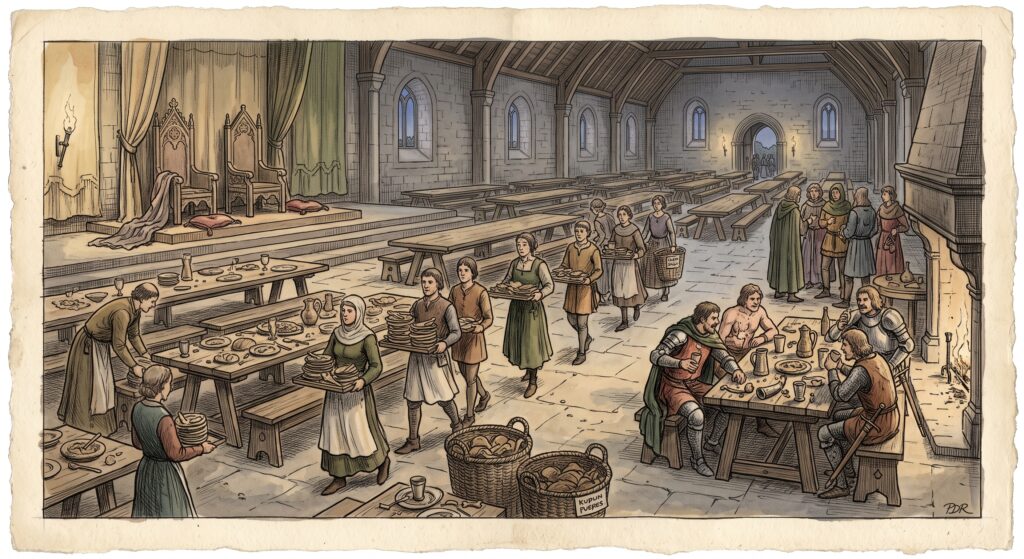
Seating in Winchester’s Great Hall was a physical diagram of feudal hierarchy:
- The High Table (Dais): Elevated at the front under an embroidered canopy (cloth of estate). King William and Queen Matilda sat at the centre, flanked by Archbishop Ealdred, papal legates, and close Flemish relatives. They ate from silver platters and drank spiced wine from pewter goblets.
- The Trestle Tables: Perpendicular tables running down the hall. Upper tables seated senior Norman commanders (like Odo of Bayeux) and bishops; middle tables held lesser barons and surviving Saxon thanes; lower tables held squires and clerks.
- The Courtyard Overflow: Common foot soldiers and local townspeople ate outdoors in canvas tents, receiving simple portions of beef, pottage, and ale.
Sanitation & Sobriety
With 1,000 people eating and drinking for hours, sanitation was tightly organised. Royalty used stone garderobes (privy closets built into castle walls that emptied into exterior ditches) or padded commode chairs (close stools). General guests used timber privy annexes set up outside filled with sawdust, while courtyard crowds used dug trench latrines lined with quicklime.
While alcohol was consumed in large quantities, Norman courtoisie (courtly discipline) strictly forbade visible drunkenness in the presence of the King and Queen. Marshals continuously patrolled the tables; any guest who became belligerent or vomited was quietly escorted into the courtyard by household guards.
When dusk fell and the royal party formally retired, the uneaten roasts and soaked bread trenchers were gathered into large wicker baskets and distributed at the castle gates to the poor of Winchester—completing a royal spectacle that fused piety, power, and political domination.

This Post Has 2 Comments
Is any of this true? The level of detail suggests some embelishment. Plus wasn’t Matilda crowned at Westminster, not Winchester? Winchester Castle’s Great Hall was built 150 years after this was meant to have taken place. The Concorde pear was bred in the 1970s.
Hi Peter
Thankyou for your comments and for taking the time to share this—you are absolutely right on all counts!
Historians agree that Matilda of Flanders was crowned at Westminster Abbey on Whitsunday, May 1068. While exact records of the post-ceremony banquet location are sparse, logistical common sense dictates it almost certainly took place locally in Westminster (likely at the Royal Palace) rather than moving the entire court, provisions, and retinue to Winchester just days after the ceremony.
You are also spot-on regarding the pears! Concorde pears are indeed a 20th-century variety (apparently first bred in 1968), so serving them 900 years earlier would have required a time machine. Medieval cooks would have used hard, cultivated cooking pears or wild varieties poached in honey and wine instead.
I chose Winchester as the backdrop for the piece because of its role as the traditional Saxon capital, housing William’s treasury, and serving as the frequent site for his official curia regis and Pentecost crown-wearings. However, using it for this specific post-coronation feast was an illustrative setting meant to showcase the vast scale, logistics, and recipes of early Norman feasting.
I really appreciate your feedback helping keep the historical details sharp. Thanks again for letting me know!