Edith the Fair, known to history as Edith Swanneck, was one of the most enigmatic and, in some ways, powerful women of 11th-century England. Her story is fundamentally intertwined with that of her partner, King Harold Godwinson, but she was a figure of substance and achievement long before he was crowned, and she lived a significant life afterward. Her position—that of a common-law wife—defines much of her historical record, yet her contributions went far beyond the domestic sphere. What were her achievements, and what was the fate of the woman who held the final, crucial knowledge of the Last Saxon King?
Achiever in Her Own Right
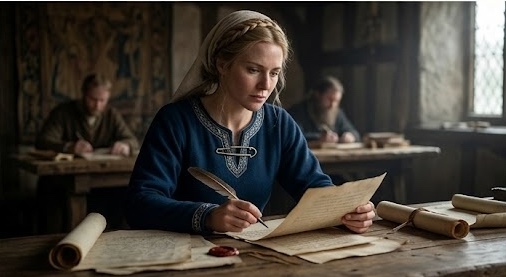
Edith was not merely a shadow; she was a major political and economic player in pre-Conquest England. Raised by a Viking chief, she understood the brutal landscape of power. Born around 1025, she came of age in an era defined by a blend of Anglo-Saxon and Scandinavian cultural and military influences. Her nickname, “Swanneck,” often interpreted as a sign of delicate beauty, is more likely a corruption of “Gentle Swan,” reflecting a gentle nature that masked her formidable position. Her primary achievement was being one of England’s wealthiest magnates.
She was an independent landholder, possessing vast estates in her own name, a rarity for any woman in the medieval world. She was the lady of Walsingham and held lands across East Anglia and the Southeast. This autonomous power base made her a significant figure, and her union with Harold Godwinson, then a powerful earl, was not a step into dependency, but a combining of already immense interests. When the Norman Conquest stripped her of her lands, they passed to major Norman lords, a testament to their value and strategic importance.
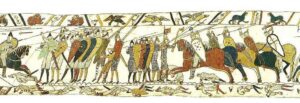
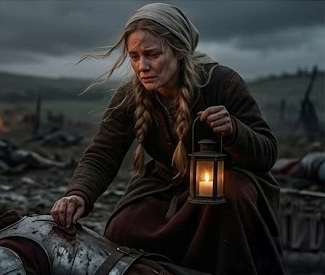
Her most celebrated achievement, an act of singular devotion and courage, secured her place in national memory. Following the devastating defeat at the Battle of Hastings in 1066, Harold’s mutilated body was unrecognizable, left amongst thousands of others. The Normans, initially, refused all pleas to release his remains for burial. It was Edith who walked through the carnage of the battlefield, meticulously searching the fallen until she identified her lover. History records that she was the only one with the specific knowledge to find him, not by his face, but by intimate markings known only to her. Her act allowed Harold to receive a proper Christian burial by the monks at Waltham Abbey, which he had founded. This portrait captures that powerful, intimate moment.
The Status of ‘Common Law Wife’
Edith was, for over twenty years, the recognized consort and first wife of Harold Godwinson, yet they were never “formally married” according to the rising, more rigid rules of the Catholic Church. Their union was likely formalized in the 1040s by the ancient Danish custom of “handfasting,” known as mores danico (in the Danish fashion). This process was a legitimate, recognized contract in the eyes of their culture, making their relationship as binding as any Christian ceremony, and their numerous children, including five sons (Godwin, Edmund, Magnus, Gytha, Gunnhild, and Ulf), were not viewed as illegitimate.
However, after Harold became King in 1066 and needed to secure his new, tenuous position against Norman, Norwegian, and Mercian threats, he was prevailed upon to make a politically strategic, canonical marriage to Edith of Mercia, the widow of his defeated Welsh enemy. This second marriage, purely one of political convenience, produced no children and saw Edith Swanneck, the love of his life and mother of his heirs, set aside but never politically neutralized.

What Happened to Her and Her Sons?
After the Battle of Hastings and her identification of Harold’s body, Edith the Fair largely disappears from the historical record, a common fate for Anglo-Saxon nobility who fell outside the Norman sphere of interest. Her landholdings passed entirely to Norman hands, most notably Alain of Richmond. Some theories suggest she may have entered a nunnery, but it is more probable that she went into exile, joining her children and mother-in-law, Gytha Thorkelsdóttir, in their attempts to organize resistance. She likely travelled to Ireland or Denmark.
The fate of her sons was a saga of repeated attempts to reclaim their lost legacy. Her eldest son, Godwin, was only 17 at his father’s death, but he, along with his brothers Edmund and Magnus, quickly became a figurehead for resistance. After their initial fails to hold Exeter in 1067, they fled to the court of Diarmuid, King of Leinster, who had previously sheltered their father. With an army supported by Diarmuid, the brothers mounted two large-scale, failed invasions of England (in 1068 and 1069) from Ireland, but were defeated. After these failures, they were forced deeper into exile.
The sons eventually found refuge in the court of their cousin, King Sweyn II of Denmark. While Magnus later entered the service of the King of Poland, Godwin and Edmund likely remained in Sweyn’s service. One son, Ulf, was captured by William the Conqueror and imprisoned until William’s death in 1087, later entering the service of William’s son. Despite their military capabilities and powerful lineage, none of the sons were ever able to regain a meaningful foothold in England. Their final legacy was one of service to foreign powers.
Edith Swanneck died around 1086, at approximately 61. She was a woman who navigated an extraordinary life and played a critical, if overlooked, role in one of history’s greatest turning points. Her final, direct legacy, however, is astounding. Through her daughter Gytha, who married the Grand Prince of Kiev, Edith’s bloodline directly flows into all the current royal houses of Europe, including back into England.