In the annals of medieval history, few transformations are as breathtaking as the rise of the Normans. In just a few generations, they evolved from Viking raiders settled in northern France into the most formidable kingmakers of Europe and the Mediterranean. This rapid expansion—spanning from the rainy shores of Normandy to the sun-drenched palaces of Sicily—is often called the ‘Norman Miracle.’ Yet, this miracle did not begin in a palace; it began in a modest manor in the Cotentin Peninsula, in the hands of a minor lord named Tancred of Hauteville.
Tancred himself never led an army into Italy or wore a crown. By all accounts, he was a typical knight of the lower nobility—brave, pious, and intensely loyal to the Dukes of Normandy. However, Tancred left a legacy far more potent than land or gold: twelve fighting sons.
Living in a feudal system governed by primogeniture, Tancred faced a crisis. His modest estate at Hauteville-la-Guichard could not support a dozen ambitious young men. Rather than allowing his house to fade into obscurity, Tancred instilled in his sons a relentless drive for “land and honor.” He raised them with the martial prowess of the Northmen and the diplomatic cunning of the Franks. When the borders of Normandy became too small for their ambitions, Tancred’s sons looked south.
The “miracle” began in earnest when Tancred’s eldest sons, William Iron-Arm and Drogo, set out for Southern Italy around 1035. At the time, the region was a chaotic patchwork of Byzantine Greek influence, Lombard principalities, and Saracen strongholds.
Initially serving as mercenaries, the Hauteville brothers quickly realized that their superior heavy cavalry and disciplined tactics made them indispensable. They didn’t just fight for the highest bidder; they carved out their own territories. By the time of William’s death, the Hautevilles had transformed from hired swords into the Counts of Apulia, laying the foundation for a permanent Norman presence in the Mediterranean.
If Tancred provided the spark, his son Robert Guiscard (the “Cunning”) provided the wildfire. Robert arrived in Italy as a penniless adventurer, but his brilliance in both warfare and statecraft was unmatched. He expanded the family’s reach, eventually securing the title of Duke of Apulia and Calabria from the Pope himself.
Guiscard’s greatest contribution to the Norman Miracle was his ability to synthesise cultures. He didn’t just conquer; he integrated. Under the Hautevilles, Southern Italy became a melting pot where Norman administration, Byzantine law, and Islamic science coexisted. This cultural synthesis would later become the hallmark of the Norman Kingdom of Sicily.
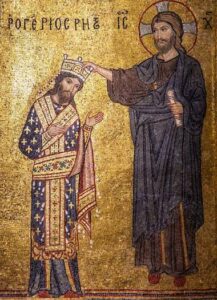
While Robert conquered the mainland, Tancred’s youngest son, Roger I, took on the monumental task of reclaiming Sicily from the Kalbid Emirate. The conquest took thirty years, but it resulted in one of the most prosperous and tolerant states of the Middle Ages. Roger’s descendants would go on to be crowned Kings of Sicily, ruling over a “Golden Age” where the Hauteville name was synonymous with European power.
Tancred of Hauteville died in Normandy, likely never imagining that his name would echo through the halls of history as the father of kings. His contribution to the ‘Norman Miracle’ was not found in a singular battle, but in the character and ambition he forged in his children. Today there is a small museum in his Norman village dedicated to his legacy. He transformed a surplus of sons into a surplus of states. The Hautevilles proved that with enough daring, the margins of society could become the center of civilisation. The “miracle” was, in reality, a masterclass in social mobility—a testament to how one minor lord’s vision could redraw the map of the world.