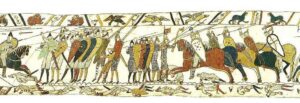
Just over 150 years after the Frankish monarch Charles the Simple gave Neustria to the Viking Sea King, Rollo the Walker, the Normans of 1066 defeated the Anglo-Saxons in the Battle of Hastings. But was William the Conqueror’s army Viking or French?
The invasion force consisted of Normans and their allies. The former were largely descendants of the Norsemen who once settled in the region that became Normandy in northern France. Originally, these Vikings assimilated with the local Frankish and Gallo-Roman populations, adopting many aspects of French culture over time. By 1066, the Normans were deeply intertwined with French culture and society. The language they used was Norman French, a Romance language that evolved from Old French and was heavily influenced by Old Norse (Gamle Norse). But despite their Viking heritage, by the time of the Conquest of England in 1066, they were primarily French in culture and language.
It all started in the 8th century after Rollo, the Duchy’s founder, sailed up the River Seine with a great fleet and besieged Paris. He attacked the adjacent area, including many towns in Neustria, which would later become Normandy. Rollo was bought off with a gift of the city of Rouen, the title of Count and the king’s daughter in marriage in 911. In return, he converted to Christianity and took on the job of preventing other people like himself from doing the same. He and his son received permission to ‘regulate’ the ‘country of the Bretons along the western coast’ (Lower Normandy), which at the time was overrun by autonomous bands of pagan Norsemen. In reality, until the very end of the 10th century, the power of the Norman state was limited to the eastern half of what became the Duchy of Normandy. Every new wave of newcomers would have been pagan and entirely independent: their assimilation into the Norman people was slow and unsteady.
The consolidation was made later through the marriage of Count Richard 1st to a pagan-born Norse woman called Gunnor, who had inherited the western lands. In the 1020s, the Norman ruler Richard 2nd (William’s grandfather) continued to consolidate further in a continuous, if tentative, hold over what is now called Normandy. He began to use the ducal title (dux) on his own authority, without consulting the French king to whom he had sworn loyalty.
By the time of William the Conqueror, there would still have been noticeable differences between the Normans in the Rouenais, French-speaking and part of a principality following the rules of the Carolingian model, and the rough-and-ready settlers of Lower Normandy. In practice, the points of difference were already blurring and did not prove a cultural fault-line. When rebellion tested the Norman dukes, they were invariably led by French-speaking members of the court, not by insurrectionists of Norse descent. Noblemen were mostly of Frankish (Old French) stock.
The Normans of Upper Normandy pointedly differentiated themselves from the Franks as a different people to themselves. By the 11th century, French-speaking Norman authors were describing the country and martial spirit of the Franks as a group of completely separate people. At the same time, these Francified people were referred to as “French” and were largely centred around Lower Normandy. The custom for rulers of the Duchy of Normandy “paying homage” to the French monarch had not yet come into practice. The Duke of Normandy was independent of the French Capetian King in the same way as the rulers of, say, Toulouse or Flanders.
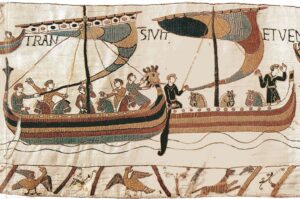
So, by the time of William the Conqueror arrived, the Norman duchy in Rouen had been founded on French Carolingian principles. Its elite ruling class were accepted among the highest echelons of the former Frankish empire. However, there was not yet a “France” that we would recognise today. The Norman noblemen and women remained fully conscious of their links to the Norse cultural world, with which they continued to resonate and cooperate. This fact was exemplified by Viking fleets allowed to use parts of the Duchy as safe havens during their attacks on Saxon England.
While the Normans may have originated as Vikings, there were still cultural differences among the population themselves. They did not arrive in France as one homogenous group nor under one authority – new groups came, settled and assimilated.
William the Conqueror’s army was actually a patchwork of soldiers of fortune and a hardcore of steadfast Norman warriors. His indigenous troops were the result of the consolidation of groups of settlers that had arrived during the past century and a half. But were they French or Viking? The answer is that they were neither, or perhaps a bit of both. William the Conqueror was undeniably Norman, a distinct identity born from Viking roots and French refinement. His success in 1066 was a testament to this unique blend, which would go on to shape English and French history for centur

This Post Has 2 Comments
On my father’s side surname Dallison came over with William the Conqueror in 1066. He was from Alencon
Interesting stuff, Karen. I have cycled up the very steep hill to Alençon a few times now to research my books and often wondered how the Duke of Normandie managed to take the town as he did. Apparently, he besieged the town from 1051 to 1052, when a personal insult spurred him to great fury, and as soon as he won, he cut the defenders’ hands and feet off.