The What-if Moments from a Tumultuous Year
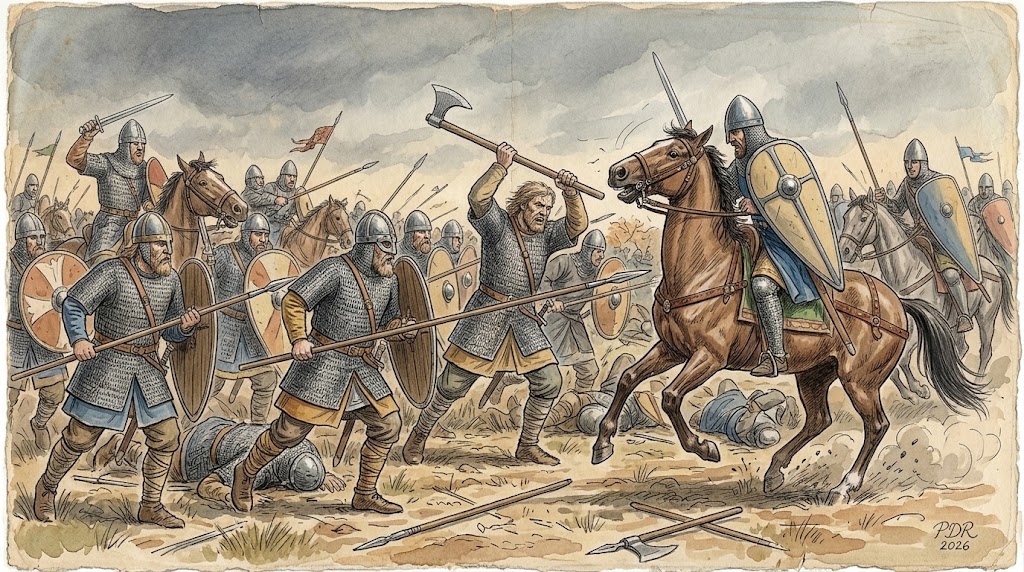
The year 1066 is etched into history as the ultimate turning point for the British Isles—a hard boundary separating Anglo-Saxon England from the Anglo-Norman empire. We often view the Norman Conquest with a sense of historical inevitability: the fading, archaic Saxon shield wall yielding to the modern, mounted prowess of Duke William. Yet, history is rarely inevitable. The events of 1066 were governed by a chaotic cascade of micro-moments—sliding doors where a single gust of wind, a tactical misstep, or a flash of impatience could have entirely taken the destiny of Western Europe along a different course.
What if the dice of 1066 had rolled differently?
1. The Papal Banner and the Winds of Fate
Before a single blade was drawn, William’s enterprise rested on two fragile foundations: divine legitimacy and the weather.
What if the Pope had refused the Papal Banner?
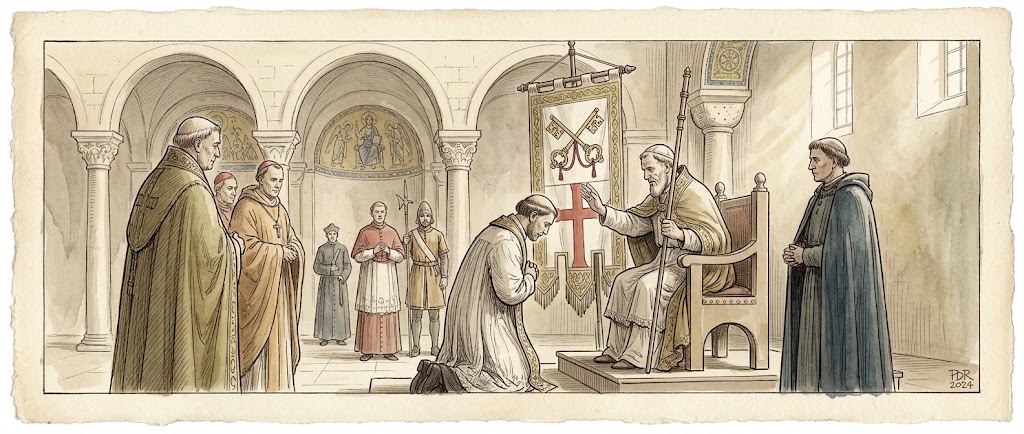
When William sought the Pope’s blessing, Archdeacon Hildebrand secured the vital Papal Banner, transforming a personal land dispute into a holy crusade. Before William and Matilda’s ‘devotional’ programme of building religious institutions began, the Duke needed atonement with the Holy See and was under threat of excommunication for his ‘crime’ of consanguinity. Without the Papal sanction, the Duke’s recruitment drive across Flanders, Brittany, and France would have withered on the vine. Any continental knight who crossed the Channel for absolution and plunder would therefore have viewed the invasion as an illegal, risky gamble against a crowned Christian king. In consequence, William’s force would have been significantly smaller, less cohesive, and stripped of any moral authority.
What if the prevailing winds had delayed the invasion fleet’s departure?
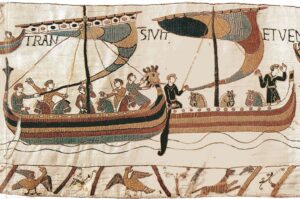
For weeks in late summer, adverse northerly winds pinned William’s fleet in Normandy. Had those winds held for just two weeks longer into October, William’s massive, quartered army would have run out of provisions, faced disease, or suffered catastrophic damage in the late-autumn storms. Alternatively, had the winds shifted in August—before Harald Hardrada struck the north—William would have landed to find Harold Godwinson waiting with a fresh, fully supplied, and well-rested army lining the southern coast. As it was, the English King, believing the threat of invasion was receding, sent the defending forces of the local fyrd home to collect the harvest. The south coast of England was largely unprotected.
2. The Northern Crucible: Fulford Gate and Stamford Bridge
In September, the Norwegian king Harald Hardrada landed in Yorkshire with 300 longships.
What if Earls Edwin and Morcar had won at Fulford Gate?
On September 20, the young Northern Earls Edwin of Mercia and Morcar of Northumbria clashed with Hardrada outside York. They fought bravely but were eventually overwhelmed, but it was by no means a foregone conclusion. Had Edwin and Morcar secured victory or held a defensive stalemate, King Harold would never have been forced to push his army through an extraordinary, 200-mile forced march northward in four days.
Instead of fighting the brutal, bloody battle at Stamford Bridge—where Harold destroyed the Norwegian threat but lost vital veteran troops—the English army could have remained ready in London, rested and completely intact.
3. The London Gambit: What If Harold Had Waited?
After winning at Stamford Bridge, Harold received news of William’s landing at Pevensey. He rushed south, gathering what levies he could along the way, and, without giving his exhausted troops any respite, offered battle at Senlac Hill after only a few days’ rest in London.
What if Harold had stayed in London and waited for reinforcements?
Harold’s brother, Earl Gyrth of Wessex, famously urged the King to remain behind Roman London’s formidable walls to recover, assemble the full strength of the national fyrd, and lay waste to the Sussex countryside to starve the Normans out.
Had Harold listened, he could have sent Gyrth south with a vanguard while gathering a massive, overwhelming force of 20,000+ troops in London. Even if Gyrth had been defeated at Senlac Hill, William would have marched inland only to face a rested, well-supplied Anglo-Saxon monarch commanding an insurmountable defensive stronghold. William’s supply lines would have snapped, and his campaign would have choked in the English winter.
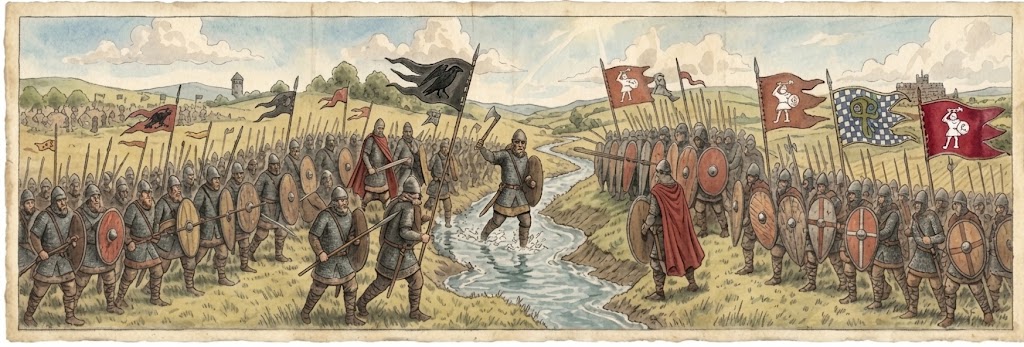
4. The Turning Point at Senlac Hill: The Shield Wall Holds
Even under-manned and exhausted, Harold’s shield wall held firm on the ridge overlooking the Norman invaders for over six gruelling hours.
What if the Saxon flank had not broken?
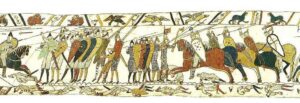
The battle turned on the famous feigned retreats—or genuine panic—of the Norman left flank. Believing the rumour that William was dead, elements of the French and Breton cavalry fled down the hill. Unable to restrain themselves, the right wing of the English fyrd broke formation to pursue them, breaking the wall’s structural integrity and allowing the Norman cavalry to return, encircle and butcher them.
Had strict discipline prevailed, the shield wall would have remained unbroken as dusk fell. In medieval warfare, an attacker failing to break a hilltop defender by nightfall often meant defeat. Exhausted, low on arrows, and trapped on a coastal strip, the Normans would have been forced into a chaotic night retreat toward their ships, with Harold’s troops pressing down from the high ground.
5. What If the Post-Hastings Rebellions Were Better Coordinated?
Even after Harold fell, apparently with an arrow to the eye, with his brothers dying beside him, the Conquest was far from complete. Between 1067 and 1075, major rebellions erupted across Northumbria, Mercia, the Fens, and the West Country.
What if the resistance had been unified?
The Saxon resistance suffered from fragmented leadership. Edgar Ætheling (the natural Saxon heir), Earls Edwin and Morcar, King Sweyn Estridsson of Denmark, and the guerrilla leader Hereward the Wake fought isolated campaigns.
Had a single, charismatic leader forged a grand coalition—perhaps combining a Danish invasion fleet, northern Anglo-Danish troops, and southern uprisings—William’s thin line of continental garrison castles would have been overwhelmed. Unable to be everywhere at once, William might never have maintained control of the North, avoiding the horrific scorched-earth campaign of the Harrying of the North.
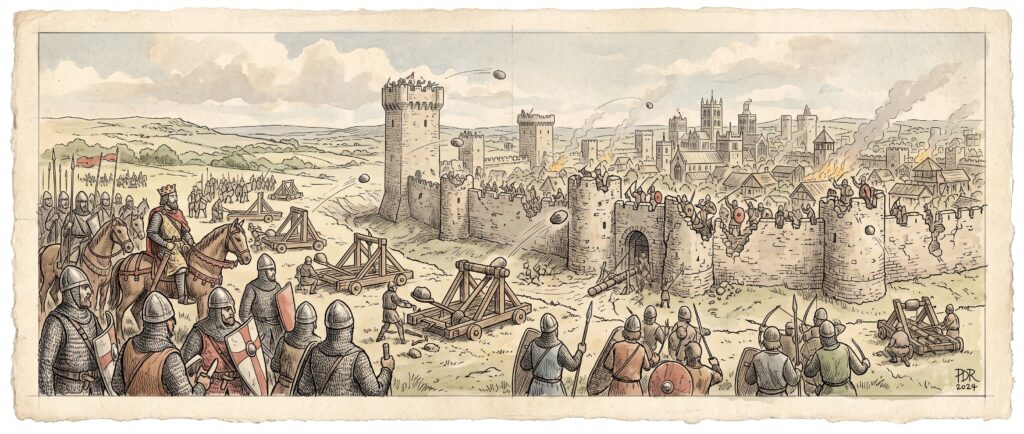
Was William Lucky, or Was Harold a Flawed General?
History often mistakes the victor for a genius and the defeated for a fool.
- Harold Godwinson was not a poor general. In less than a month, he marched 200 miles north, annihilated the greatest Viking commander of the age (Hardrada) at Stamford Bridge, marched 200 miles south, and came within a hair’s breadth of defeating a fresh, combined-arms Norman army. His sole failure was impatience—a fatal rush to engage William before his full army was assembled.
- William was undeniably a brilliant commander, but he was also, arguably, exceptionally lucky. He was blessed with an opportune wind shift, a distracted enemy, crucial discipline breaches on the enemy line, and a fatal blow that struck down the enemy king at the exact moment the battle teetered on a knife edge.
Without that extraordinary chain of fortune, William would likely be remembered not as “the Conqueror,” but as an ambitious duke who perished on a bleak English hillside.
The Alternate World After 1066
Had any of these sliding door moments swung the other way, the modern world would look radically different:
- The English language would have evolved naturally without the massive influx of Norman-French vocabulary. We would speak a purely Germanic language much closer to modern Dutch or Frisian.
- The Politics & Identity of Anglo-Saxon England would have remained anchored to the Scandinavian/North Sea sphere rather than being pulled into centuries of continental French wars (such as the Hundred Years’ War).
- The fluid pre-Conquest social structures and customary rights of the English ceorls would have endured, avoiding centuries of rigid Norman feudal serfdom.
The outcome of 1066 was not written in the stars; it was decided by thin margins, discipline errors, unseasonal winds and quite a lot of good fortune for the winner.