Reclaiming the Gritty History of the Tapestry’s Missing Scenes
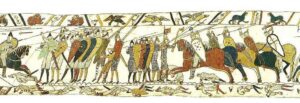
The Bayeux Tapestry, as it hangs today, ends in mid-air. The final existing stitches show a chaotic scramble: broken Anglo-Saxon soldiers melting into the dark, tangled woods of Sussex, pursued by relentless Norman cavalry. It is a cliffhanger frozen in linen for nearly a thousand years.
But history didn’t stop at the edge of the battlefield.
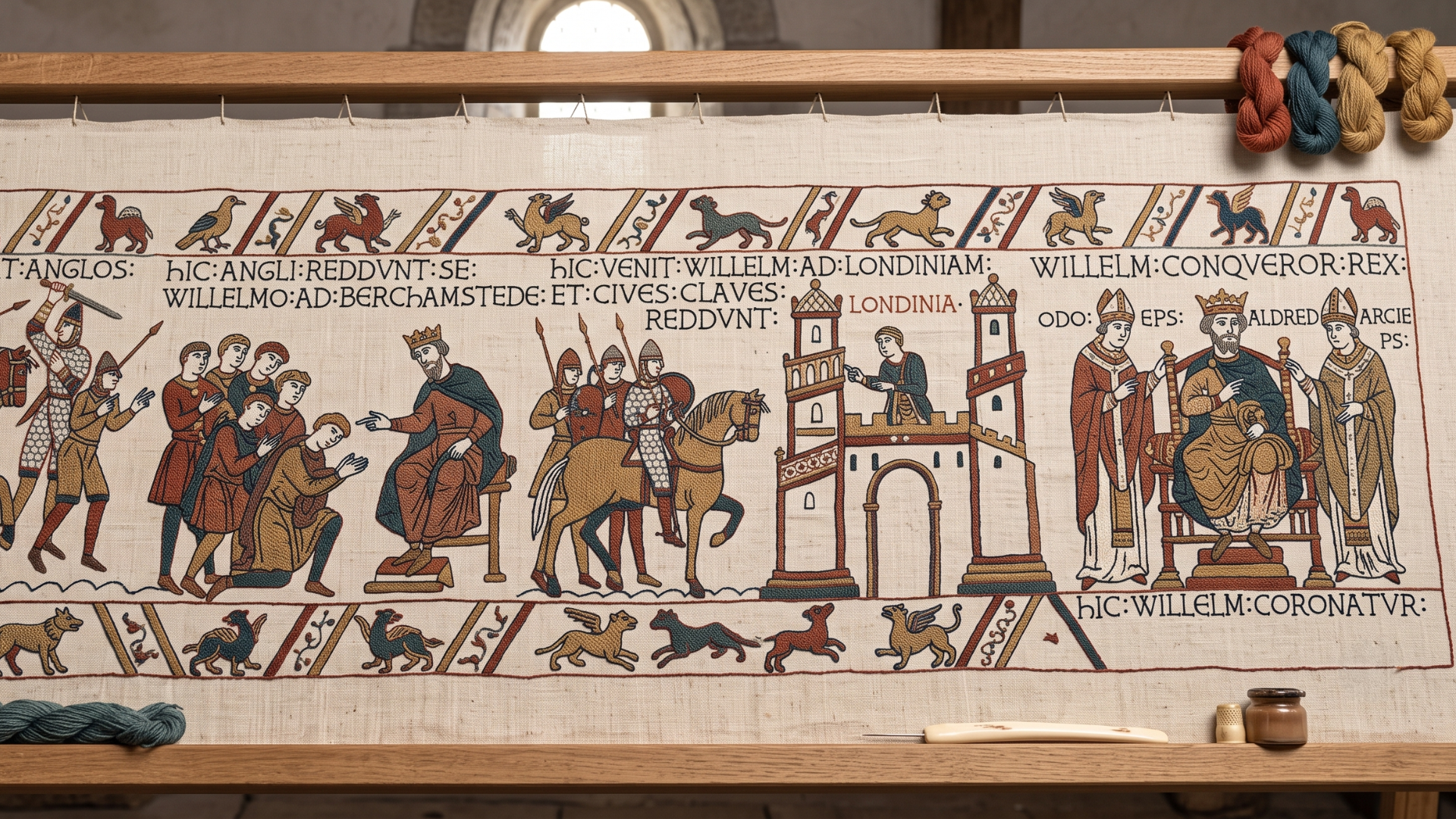
Historians widely agree that the final two to three meters of the masterpiece were torn away or rotted away centuries ago. Had it survived, this lost section would have completed the grand narrative arc designed by the Norman conquerors. It would have moved the story out of the blood-drenched mud of Hastings and into the cold, calculating halls of political submission, culminating in the ultimate prize: the crown of England.
If we were to re-stitch those lost metres today, based on the raw historical record, what would the continuing story look like? More importantly, what was the gritty reality behind the polished propaganda?
1. The Crimson Road to Dover
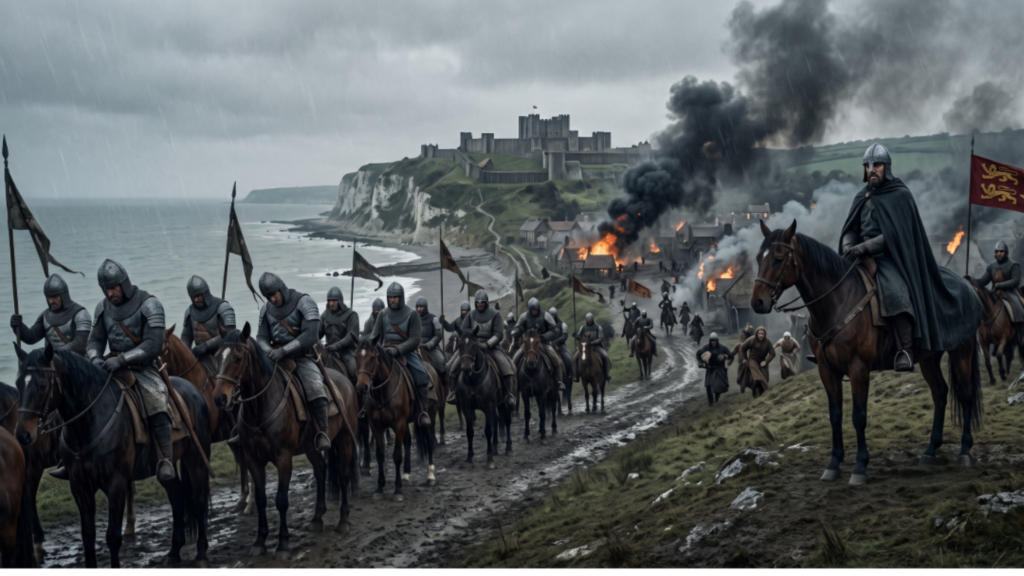
The missing panels would have begun with the immediate, brutal aftermath of October 14, 1066. The tapestry would likely depict Duke William’s cavalry sweeping across the south coast, a sequence of iron-clad riders labelled WILLELM CHASSAT ANGLOS (William chases the English).
But the reality was far from a victorious parade. The Norman army was exhausted, deeply battered, and ravaged by dysentery. William did not march straight for London; he struck out to secure his supply lines back to Normandy.
The lost embroidery would have shown the formidable stone and timber fortifications of Dover. In the official Norman version, the town keys were handed over gracefully. In the true chronicle of the march, the terrified townspeople panicked, and the Norman vanguard, eager for plunder and paranoid of ambush, set fire to the city, burning homes to ash while William looked on. It set a grim precedent for what was to come.
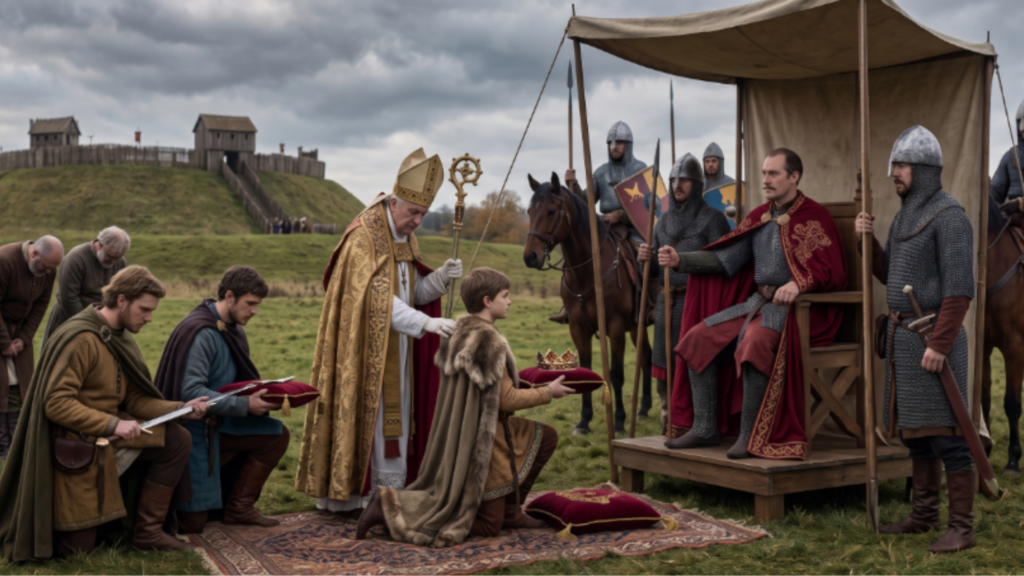
2. The Iron Noose and the Kneeling Lords
To capture London, William did not launch a foolish frontal assault against its massive Roman walls. Instead, he initiated a sweeping, terrifying loop around the capital, burning a ring of devastation through Surrey, Hampshire, and Hertfordshire to starve the city into submission.
The lost tapestry would have captured the pivotal political climax of this terror campaign: the submission at Berkhamstead.
In the missing borders and panels, we would see the proud remnants of the Anglo-Saxon elite—including the young prince Edgar the Ætheling, Earl Edwin, Earl Morcar, and Archbishop Ealdred of York—kneeling before a seated, stern Duke William. The Latin script would read ANGLI REDDUNT SE WILLELMO (The English surrender themselves to William).
To the viewers in the 11th century, this scene was meant to show voluntary capitulation. To those who lived it, it was a moment of absolute humiliation. The English lords knew that if they did not bend the knee at Berkhamstead, the smoke that had consumed the surrounding shires would soon swallow London whole.
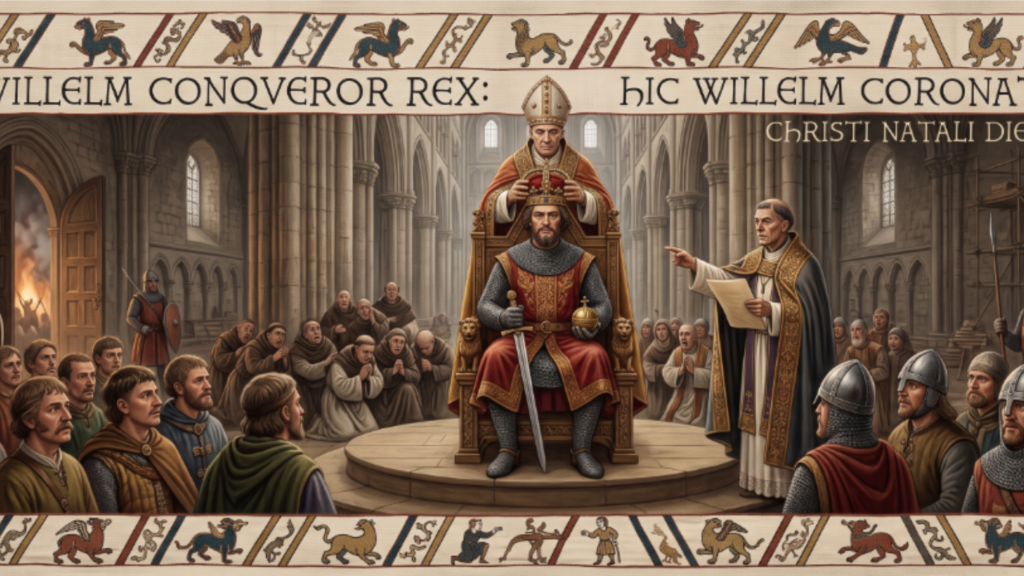
3. The Smoke-Filled Coronation
The grand finale of the entire textile epic—the scene that would have perfectly mirrored the tapestry’s opening image of King Edward the Confessor—was the coronation of William the Conqueror at Westminster Abbey on Christmas Day, 1066.
The missing embroidery would have depicted William enthroned in magnificent detail, flanked by Bishop Odo and Archbishop Ealdred, holding the sceptre and orb of English kingship. The bold lettering would read: HIC WILLELM CORONATUR (Here William is crowned).
The Gritty Reality Behind the Stitches
The tapestry would have framed the coronation as a moment of holy serenity. The actual event was a scene of pure, unadulterated terror.
When Archbishop Ealdred asked the packed congregation inside the Abbey, in English, if they accepted William as their king, the crowd shouted their assent. The Norman cavalry stationed outside, unfamiliar with the English tongue, mistaking the loud roaring for an assassination attempt or a treasonous riot.
Panicking, the Norman guards immediately set fire to the thatched houses surrounding Westminster Abbey. As smoke began to pour through the stained-glass windows and the screams of citizens echoed from the streets, the congregation fled the church in terror. William was left virtually alone inside the dark, echoing Abbey, trembling violently as the crown was hurried onto his head by terrified priests.
Beyond the Canvas: The Legacy of a Bitter Harvest
The missing end of the Bayeux Tapestry was designed to feel like a definitive full stop—the neat closure of a righteous conquest. But as the smoke over London on that fateful Christmas Day proved, the coronation was not the end of the story. It was merely the opening volley of a decades-long struggle for survival, resistance, and identity.
This violent transition is exactly where the embroidery ends, and where the true epic of human resilience begins. While the tapestry’s lost ending sought to legitimise a new regime, the raw history tells a story of a multi-generational bloodline forced to navigate the devastating cost of a crown won in blood—a theme that echoes through every shield wall, every betrayal, and every line of The Leopards of Normandie saga.