The Golden Age of the Vikings Does Not End In 1066
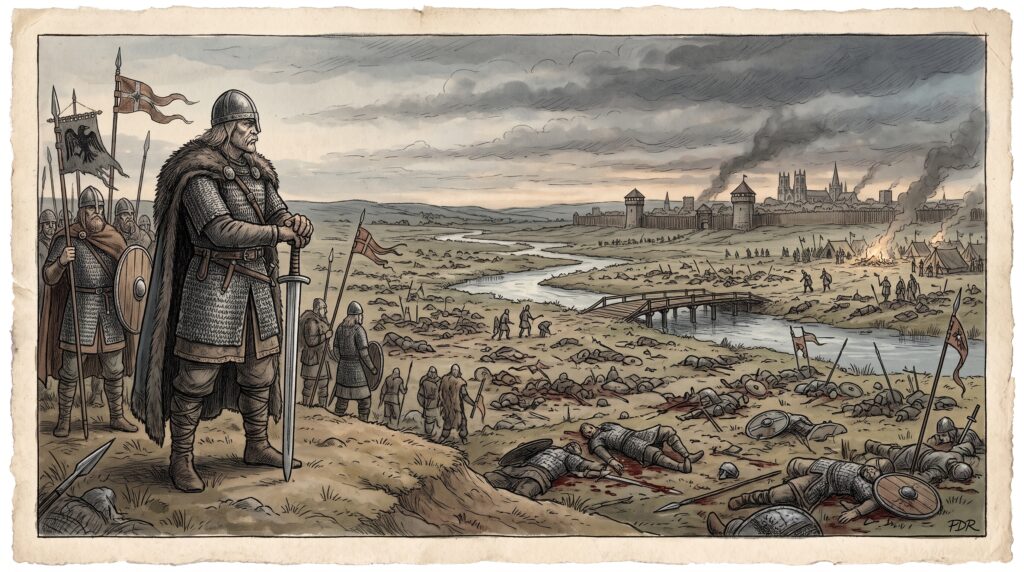
On the afternoon of September 25, 1066, an arrow pierced the throat of Harald Sigurdsson—known to history as Hardrada, “the Hard-Ruler”—and brought an abrupt end to three centuries of Scandinavian expansion into Britain and the so-called Golden Age of the Vikings. Three days later, Duke William of Normandy landed unopposed at Pevensey. Had that arrow drifted three inches wide, the course of European history would have fractured. A surviving Hardrada at Stamford Bridge fundamentally would have changed the strategic board. It removes King Harold Godwinson from the throne, shatters the House of Wessex, and pits the preeminent heavy cavalry force of Western Europe against the most seasoned, battle-hardened commander of the medieval world.
Phase I: The Annihilation of the Saxon Crown
At Stamford Bridge, Godwinson’s lightning march caught the Norsemen without their mail coats (byrnies), yet the battle remained in the balance until Hardrada fell and Tostig Godwinson was cut down. If Hardrada holds the river crossing long enough for his rear-guard under Eystein Orre to deploy in full armour, the outcome reverses:
Harald Godwinson is Slain:
The Saxon housecarls fought to the death around their king’s dragon banner. A Norse victory means the wholesale slaughter of the core professional Saxon army.
The Fall of the North:
Hardrada and Tostig secure York. With Godwinson dead and his brothers Gyrth and Leofwine likely fallen alongside him, the legitimate Anglo-Saxon defence structure evaporates.
The Witan in Disarray:
In London, the Saxon council (Witenagemot) is left with only the teenage Edgar the Ætheling and the fractious northern Earls Edwin and Morcar, neither of whom commands broad loyalty.
Hardrada now claims the throne of England by right of his treaty with Harthacnut. Yet his army has suffered staggering casualties. He cannot celebrate; scouts riding hard from the south bring word that hundreds of Norman ships have just hit the Sussex shingle.
Phase II: William Lands in a Void
Duke William of Normandy landed at Pevensey on September 28 expecting to meet Harold Godwinson in a decisive, legitimising battle for the English crown. Instead, his scouts discover an empty south coast.
Historically, Godwinson rushed south in a panicked, thirteen-day forced march to protect his personal lands in Sussex, throwing tired troops against the Norman perimeter at Senlac Hill. Hardrada would never make that mistake.
Hardrada was not an insular Saxon warlord. He was an international mercenary general who had spent a decade commanding the Byzantine Varangian Guard in Constantinople. He had fought Arab horsemen in the Levant, Sicilian Saracens, and—most crucially—he had already fought alongside Norman heavy cavalry under William Iron Arm in the Mediterranean campaigns of the 1030s.
Hardrada understood Norman warfare better than any Englishman alive:
- He Refuses the Bait: When William ravages the Sussex countryside to provoke an immediate response, Hardrada does not budge. Sussex belongs to the dead Godwins; its burning costs Hardrada nothing.
- Consolidation of the Danelaw: Hardrada spends October consolidating York, rallying Scandinavian-descended thegns across Northumbria and the East Midlands, and treating his wounded.
- The Race for London: Leaving a strong garrison in York, Hardrada advances along the Old North Road (Ermine Street) toward London, ordering Tostig’s surviving retainers to secure the crossing of the Thames.
Phase III: The Strategic Stand-Off
William cannot sit on the coast indefinitely. His army consists of heavily armed knights, Breton mercenaries, and continental adventurers expecting land, gold, and rapid victory. Autumn is ending; foraging in the winter rains will quickly rot his supply lines.
William must march on London to force a confrontation.
When the Norman army reaches the Thames at Southwark in late November 1066, they do not find terrified ealdermen. They find the fortified Roman bridge held by a Norse-Saxon garrison, while Hardrada’s field army camps north of the river.
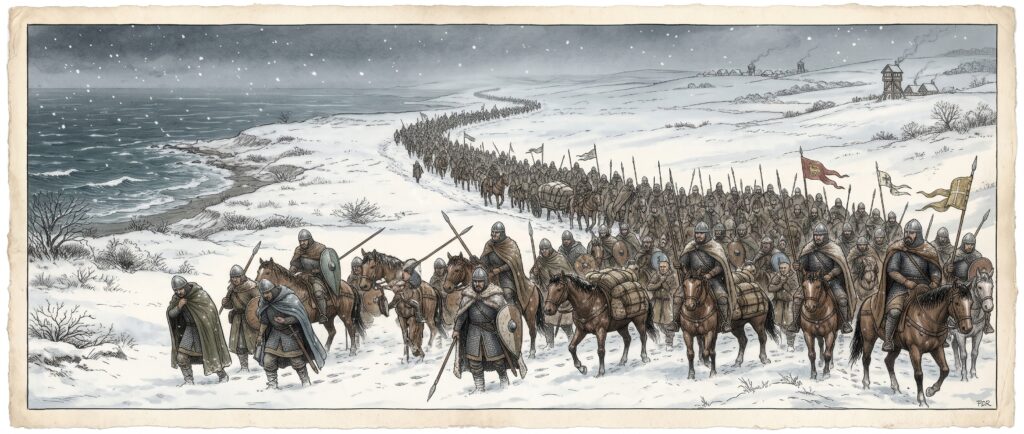
The Battle Lines Finally Take Shape: Late 1066
Norwegian Army: Hardrada & Tostig
~10,000 Heavy Infantry (Norse Veterans, Varangians, Danelaw Fyrd)
Position: North of the Thames / Anchored on London’s Roman Walls
|
The Backdrop: the Banks of the River Thames
|
The Norman Army
~7,000 Mixed Arms (Norman Knights, Breton Infantry, Crossbows)
Position: Southwark / Exposed Southern Lines of Communication
William faces a grim operational choice: attempt a bloody, narrow assault across London Bridge, or swing west to find a crossing upstream at Wallingford, dragging his supply train through hostile, waterlogged winter country.
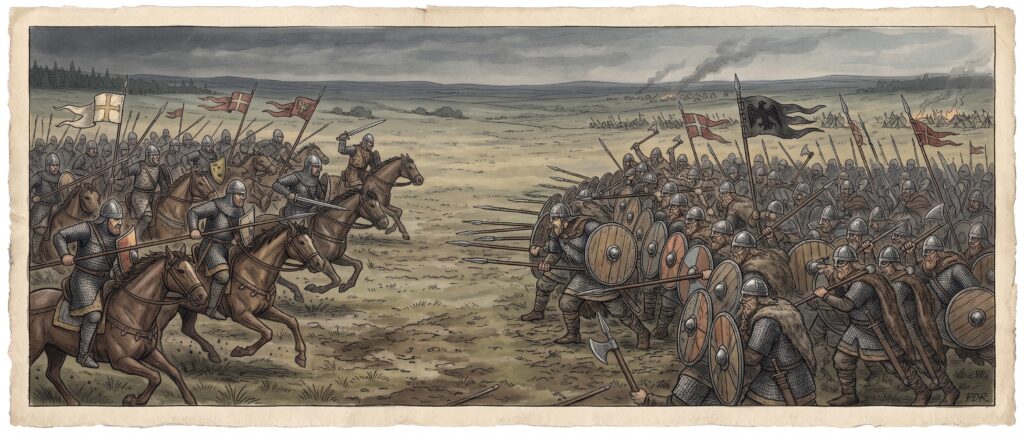
Phase IV: The Tactical Crucible — Cavalry vs. The Varangian Wall
Inevitably, the armies meet in open country north of the Thames—likely in early spring 1067, around the Chiltern approaches or the plains of Hertfordshire.
This confrontation is radically different from the Battle of Hastings:
- No Impetuous Saxon Shield-Wall: At Hastings, undisciplined Saxon fyrd broke ranks to chase fleeing Norman cavalry down Senlac Hill, exposing their flank. Hardrada’s core veterans operate with the rigid tactical discipline of the Byzantine manual, the Strategikon. When Norman conrois attempt their feigned flights, Hardrada’s line stands fast.
- Anti-Cavalry Geometry: The Norse utilize the triangular svinfylking (swine-array) and interlocking shield rings anchored by ten-foot Dane-axes and heavy boar spears designed specifically to impale charging destriers.
- The Shock of Combined Arms: William holds the undisputed advantage in ranged firepower and tactical shock. His crossbowmen and massed archers rain bolts into the static Norse ranks, while his mounted knights deliver concentrated charges with the couched lance.
If William wins, it is at a pyrrhic cost that leaves his army too depleted to subdue the rest of the island, turning the Norman conquest into an isolated occupation of the southeast.
If Hardrada wins, William falls or is captured, his continental army is dismantled, and Norman expansionism is severed at the neck.
The Aftermath: The Resurgent North Sea Empire
Had Harald Hardrada broken William north of the Thames, the entire cultural, political, and linguistic trajectory of the West would have pivoted back toward the Scandinavian sphere:
- The Rebirth of Cnut’s Empire: England becomes the western anchor of a unified northern empire encompassing Norway, the Northern Isles, and the Danelaw, turning the North Sea into an internal lake.
- The Death of the English Language as We Know It: Without the influx of Anglo-Norman French, English does not absorb the 10,000 Romance loanwords that define modern administrative, legal, and poetic English. It remains a Germanic, Norse-inflected tongue—far closer to modern Dutch, Frisian, and Icelandic.
- The Isolation of the Papacy: The Norman conquest was launched under a Papal banner granted by Pope Alexander II to bring the Anglo-Saxon church under tighter Roman reform. Under Hardrada, England remains an autonomous, rough-edged Christian realm resistant to Gregorian centralisation.
- No Angevin Empire, No Hundred Years’ War: Without Norman dukes holding the English crown, the centuries-long dynastic collision between England and France never occurs. English kings never claim Aquitaine or Normandy; their eyes remain fixed on the Baltic, Iceland, and the Rhine.
The arrow that found Hardrada’s throat at Stamford Bridge did not merely settle a succession crisis. It tore Britain out of the orbit of the northern sagas and bound it irrevocably to continental Europe.