Famous Normans Who Reshaped the Medieval World
When people hear the word “Norman,” their minds almost instantly jump to 1066, Hastings, and William the Conqueror. Yet William was merely one branch of a formidable diaspora that transformed Europe. From the fjords of Scandinavia to the olive groves of Southern Italy and the sun-baked ramparts of the Levant, Norman warriors and statesmen reshaped the political landscape of the Middle Ages. Some were succesful at assimilation, others less so. But those who triumphed, like their forebears from the north, were adaptable shapeshifters: Vikings who learned French, Norse pagan raiders who built magnificent Romanesque cathedrals, and landless mercenaries who became kings and crusader princes.
Here are the lives, times, and achievements of six legendary Normans—other than William the Conqueror—who changed history.
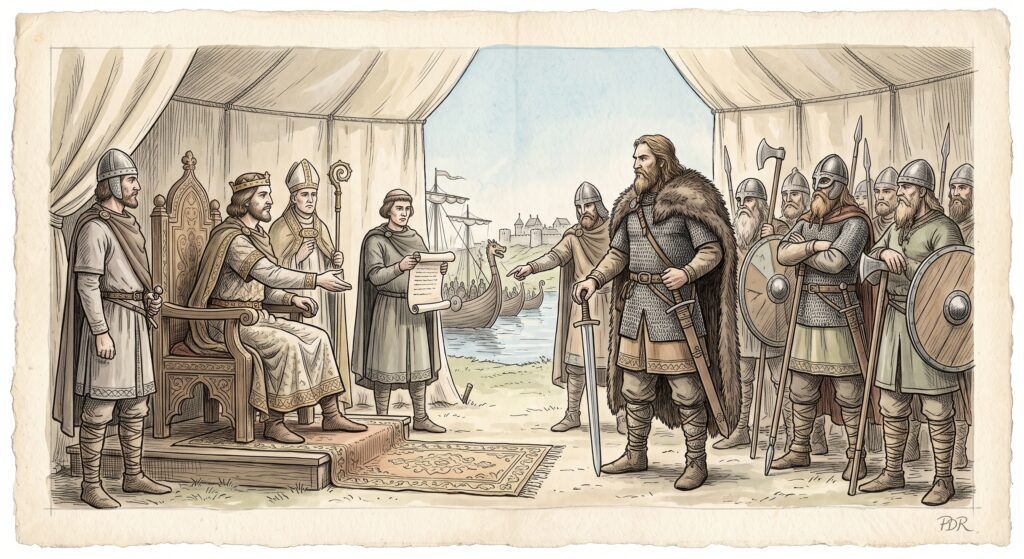
1. Hrolf Ganger (Rollo): The Founding Viking Chieftain (c. 860–932)
Before there was a Normandy, there was Hrolf Ganger (known to history as Rollo). A towering Norse chieftain whose nickname Ganger (“the Walker”) allegedly derived from being too large for any small Icelandic horse to carry, Rollo spent the late 9th century terrorising the waterways of Northern Francia. He is not to be confused with the fictional brother of Ragnar Lothbrok from the TV series Vikings.
Times & Achievements
During a period when the Frankish Empire was fracturing, Rollo led relentless Viking raids up the Seine River, even laying siege to Paris. Realising that brute force could not keep the Norsemen at bay forever, the Frankish King Charles the Simple offered Rollo a legendary bargain in the Treaty of Saint-Clair-sur-Epte (911).
In exchange for converting to Christianity and protecting the Seine estuary from rival Viking fleets, Rollo was granted feudal lordship over the lands (Neustria) around Rouen. Rollo kept his word. He stabilised the region, instituted Norse legal principles alongside Frankish customs, and established the Duchy of Normandy. Without Rollo’s administrative pragmatic genius, the Norman identity—and William the Conqueror himself—would never have existed.
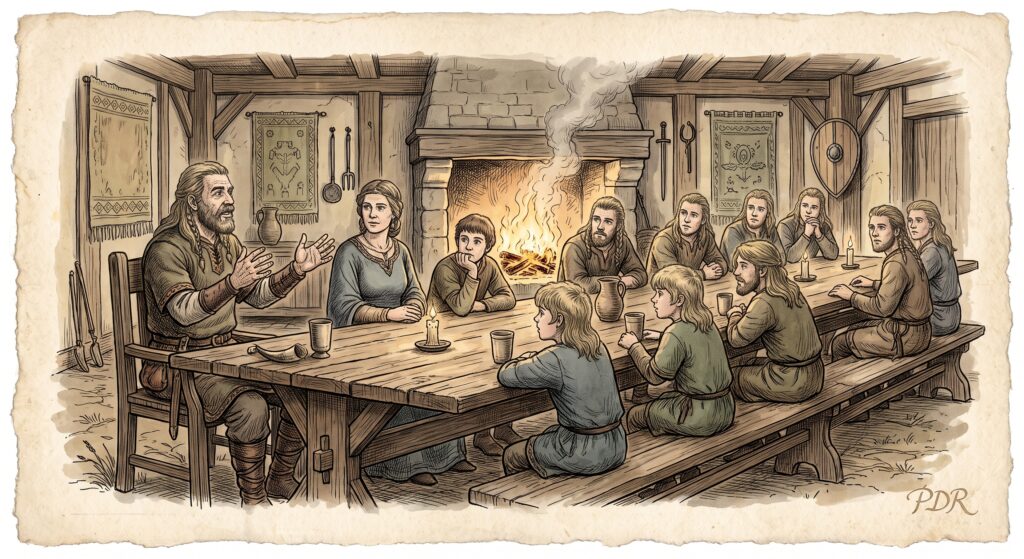
2. Tancred of Hauteville: The Prolific Patriarch (c. 980–1041)
While Rollo laid Normandy’s foundations, a minor petty baron in the Cotentin Peninsula named Tancred of Hauteville set in motion the Norman conquest of the Mediterranean. Though Tancred himself never left Normandy, his extraordinary lineage changed European history forever.
Times & Achievements
Tancred was a nobleman of modest means, famous locally for his martial prowess—legend holds he saved Duke Richard II of Normandy by killing a wild boar with a single sword blow during a hunt. However, his true historic achievement was his family tree. Through two marriages, Tancred sired twelve sons.
Because his small manor at Hauteville-la-Guichard could not support twelve ambitious heirs, Tancred’s land-starved sons were forced to seek fortune abroad. Riding south to Italy as hired swords, brothers like William Iron Arm, Drogo, Humphrey, Robert Guiscard, and Roger I systematically conquered Southern Italy and Sicily. Tancred’s fertile household became the fountainhead of the Hauteville dynasty, turning a modest Norman estate into a Mediterranean empire.
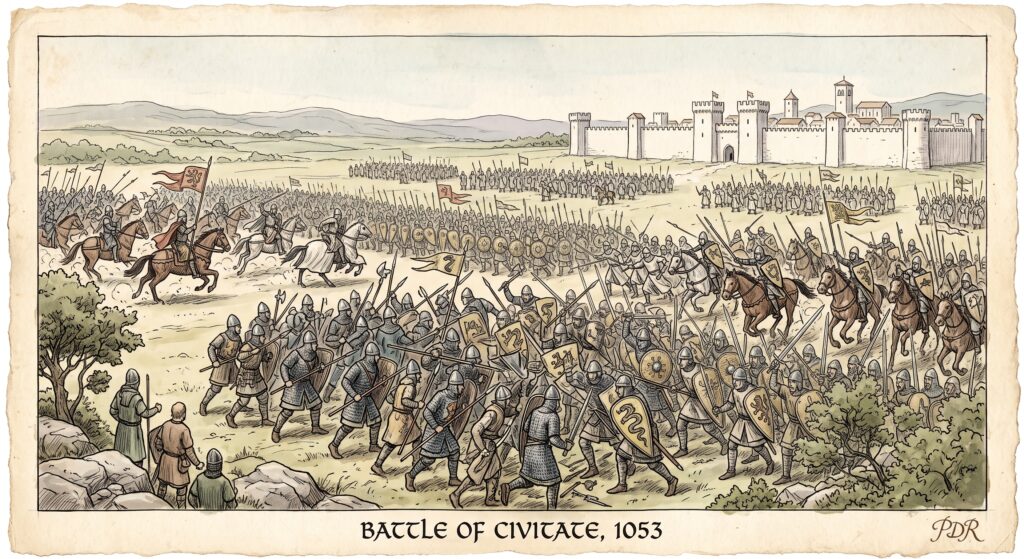
3. Robert Guiscard: The Cunning Fox of Southern Italy (c. 1015–1085)
The sixth son of Tancred of Hauteville, Robert earned the moniker Guiscard—meaning “the Cunning” or “the Crafty”—for his terrifying blend of military audacity and political deception.
Times & Achievements
Arriving in Southern Italy around 1047 with little more than his sword and a handful of horsemen, Guiscard began as a mercenary bandit in the hills of Calabria. Through shrewd alliances and relentless warfare, he conquered the region piece by piece.
In 1059, Pope Nicholas II recognised him as Duke of Apulia and Calabria. Guiscard went on to expel the Byzantine Empire from Italy after a gruelling siege of Bari (1071), drove Saracen forces from Sicily alongside his younger brother Roger, and famously sacked Rome in 1084 to rescue Pope Gregory VII from the Holy Roman Emperor. Before his death, he even invaded the Byzantine heartland, defeating Emperor Alexios I Komnenos in open battle.
4. Bohemond I of Antioch: The Mastermind of the First Crusade (c. 1054–1111)
The eldest son of Robert Guiscard, Bohemond was raised in the brutal school of Mediterranean warfare. Tall, striking, and terrifyingly intelligent, the Byzantine historian Anna Komnenos famously described him as a man whose very glance inspired dread and admiration in equal measure.
Times & Achievements
Bohemond learned statecraft fighting alongside his father against Byzantium. When the First Crusade (the successful one) was called in 1095, Bohemond seized the opportunity to carve out his own realm. He became the undisputed military brain of the expedition.
During the desperate Siege of Antioch (1097–1098), when the crusader army faced starvation, Bohemond secretly bribed a tower guard to open the city gates. After taking the city, he held off a massive Turkish relief army against overwhelming odds. Refusing to hand the prize to the Byzantine Emperor, he declared himself Prince of Antioch, establishing a powerful Norman state in the Levant.
5. Tancred of Hauteville: The Crusader Lion (c. 1072–1112)
Grandson of the patriarch Tancred of Hauteville and nephew to Bohemond I, this younger Tancred embodied the high medieval ideal of the fearless Norman crusader knight. Bold, ambitious, and fiercely competitive, he came of age during the explosive expansion of Norman power in the Middle East.
Times & Achievements
Joining his uncle Bohemond on the First Crusade, Tancred quickly distinguished himself as one of the campaign’s most brilliant tactical commanders:
- Tactical Audacity: Captured Tarsus and secured vital mountain passes through the Taurus range.
- Jerusalem (1099): Was among the very first crusader commanders to scale the walls of Jerusalem during the final assault.
- State Building: Appointed Prince of Galilee and later served as Regent of the Principality of Antioch, spending years defending and expanding crusader territory against surrounding Muslim emirates and Byzantine armies.
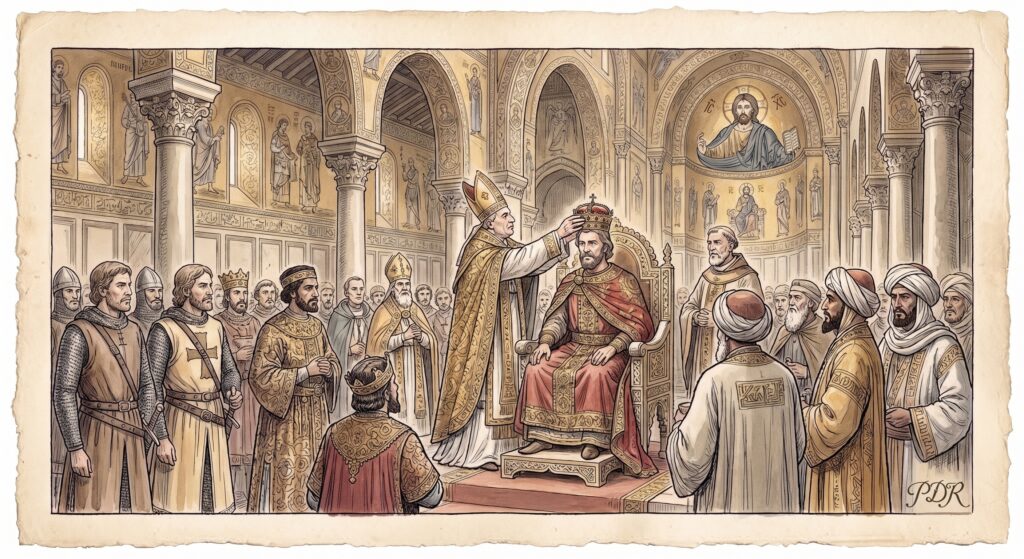
6. Roger II of Sicily: Architect of the “Kingdom in the Sun” (1095–1154)
Son of Roger I and grandson of the patriarch Tancred, Roger II transformed the piecemeal conquests of his family into one of the most sophisticated, wealthy, and culturally brilliant kingdoms of medieval Europe.
Times & Achievements
Crowned the first King of Sicily at Christmas in 1130, Roger II united Southern Italy and Sicily into a centralised maritime power. Rather than forcing cultural assimilation, Roger created a famously cosmopolitan, multi-ethnic court in Palermo:
- Administrative Genius: Blended Norman feudal governance with Greek-Byzantine bureaucracy and Arab economic management.
- Cultural Renaissance: Hosted Arab scholars and Latin thinkers side-by-side, commissioning the famous world map (Tabula Rogeriana) from geographer al-Idrisi.
- Architectural Marvels: Constructed the Palatine Chapel in Palermo, combining Norman stone arches, Byzantine gold mosaics, and Arab stalactite (muqarnas) ceilings.
Comparison Chart
Name | Active Period | Primary Region | Greatest Achievement |
Hrolf Ganger (Rollo) | c. 860–932 | Normandy (Francia) | Founded Normandy; established Norman rule at Rouen (911). |
Tancred of Hauteville (1st) | c. 980–1041 | Normandy | Prolific patriarch whose 12 sons conquered Southern Italy and Sicily. |
Robert Guiscard | c. 1015–1085 | Southern Italy & Balkans | Conquered Apulia/Calabria, expelled Byzantines from Italy, sacked Rome. |
Bohemond I | c. 1054–1111 | Levant (Antioch) | Military brain of First Crusade; founded Principality of Antioch. |
Tancred of Hauteville (2nd) | c. 1072–1112 | Levant (Outremer) | Crusader hero; captured Jerusalem walls and ruled Galilee/Antioch. |
Roger II | 1095–1154 | Sicily & Southern Italy | Created the Kingdom of Sicily; built a thriving multicultural empire. |
William the Conqueror may be the most famous Norman, but his compatriots made their mark in no less dramatic fashion. The Norman legacy extended far beyond the battlefield of Hastings. From Rollo’s longships on the Seine to the vast dynastic ambition spawned in Tancred’s modest Norman manor, these figures demonstrated the terrifying drive, administrative agility, and martial prowess that made the Normans the true titans of the medieval world.