Did the Normans Really Launch the British Empire?
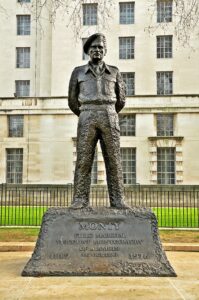
When Field Marshal Bernard Montgomery reflected on the arc of British military history, he was prone to sweeping, decisive judgments. Among his most provocative historical assertions was the idea that the Norman Conquest of 1066 was not merely a conquest of England, but the essential catalyst that paved the way for the global expansion of the British Empire centuries later.
To modern ears, linking a medieval feudal land-grab with the red-mapped global empire of the 19th century sounds like an audacious leap. It raises a fascinating historical question: Was Monty onto a profound structural truth about how the English state was forged, or was his judgment clouded by a romantic affinity for his own aristocratic Norman lineage?
To answer that, we must weigh the mechanics of the Conquest against the realities of imperial history—and take a close look at the Field Marshal’s family tree.
The Pro-Thesis Case: The Blueprint for Empire
There is a compelling historical case that 1066 established the exact state machinery, military doctrine, and expansionist mindset required to build a global empire.
1. The Marcher Lord Model: “Colony Zero”
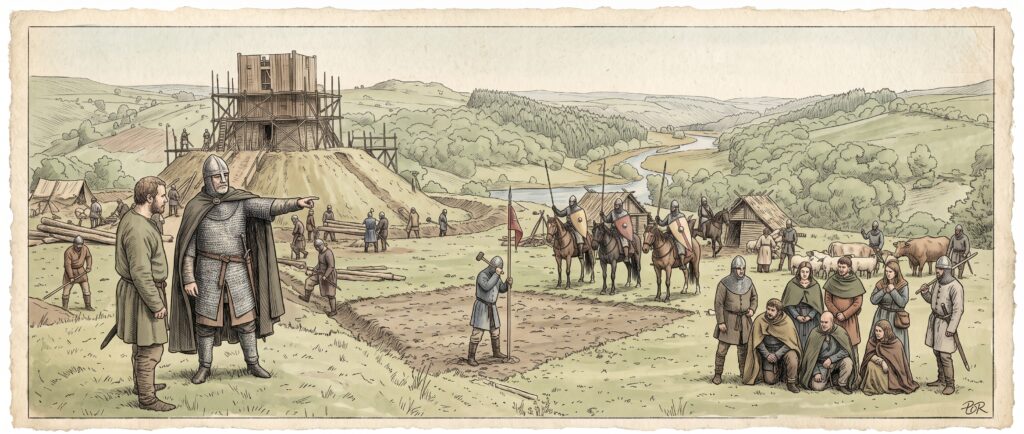
Before Britain colonised Ireland, the Americas, or India, it practiced the mechanics of subjugation closer to home. Following 1066, William the Conqueror established autonomous military commanders along the Welsh border—the Marcher Lords. Men like Roger de Montgomery were granted sweeping legal immunities to build castles, seize land, and subjugate local populations.
This Marcher strategy was the original prototype for British imperialism. The techniques perfected in the Welsh Marches and later in Strongbow’s 12th-century invasion of Ireland—fortified strongpoints, foreign land redistribution, economic extraction, and legal disenfranchisement of native populations—became the standard operating procedure for British colonial expansion across the globe.
2. Radical Centralisation and Resource Extraction
Empires cannot be built on loose confederations or decentralised tribal loyalty; they require hyper-efficient resource mobilisation. Anglo-Saxon England was wealthy, but its administrative power was dispersed among regional earls. William the Bastard smashed this system, replacing it with a rigid feudal pyramid where all land belonged directly to the Crown.
The culmination of this was the Domesday Book of 1086—an administrative feat of taxation and land mapping unprecedented in Western Europe. This centralised tax-collecting machine gave the English monarchy a capability for sustained fiscal extraction that funded centuries of overseas campaigns, from the Hundred Years’ War to the expansion of the Royal Navy.
3. The Shift from Defence to Power Projection
Prior to 1066, England looked eastward and northward toward Scandinavia, perpetually defending its coastlines against Viking raiders. The Normans violently reoriented England toward continental Europe. By binding the English Crown to vast territorial holdings in France, the Conquest embedded a aggressive, outward-looking military tradition into the national DNA. England ceased to be a target of foreign conquest and became a launcher of overseas expeditions.
The Anti-Thesis Case: Anachronism and Imperial Reality
Despite these structural parallels, critics argue that attributing the British Empire to the Normans is a massive exercise in historical hindsight that ignores how the modern empire actually came to be.
1. The Industrial and Maritime Gap
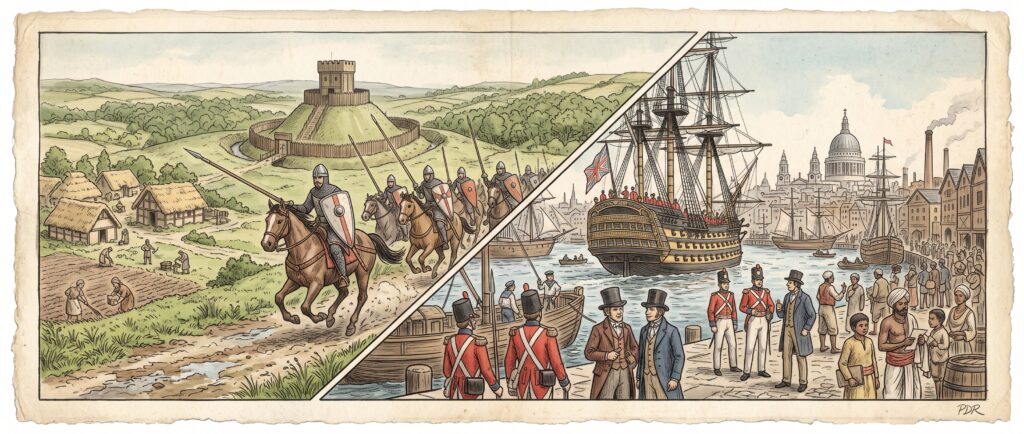
The British Empire was not built by feudal knights in chainmail or territorial barons; it was built by blue-water naval dominance, joint-stock trading companies (like the East India Company), industrial manufacturing, and Atlantic trade routes.
The Norman elite was fundamentally agrarian and land-obsessed. The empire that conquered a quarter of the globe was born out of the 17th and 18th-century commercial revolutions—phenomena rooted in Protestant merchant culture, parliamentary capitalism, and coal-driven industrialisation, none of which existed in the high medieval world of William the Conqueror.
2. Hijacking Anglo-Saxon Roots
It is also unfair to give the Normans sole credit for English administrative efficiency. The Normans did not invent the shire system, the office of the sheriff, the silver coinage, or the royal writ system—they inherited them directly from the Anglo-Saxons. William’s genius lay not in inventing a new state apparatus, but in weaponizing the sophisticated Saxon machinery he had captured. To credit the Normans alone with creating the engine of empire ignores the Saxon bedrock that made the state functional in the first place.
The Ancestral “Rota”: Was Monty Biased?
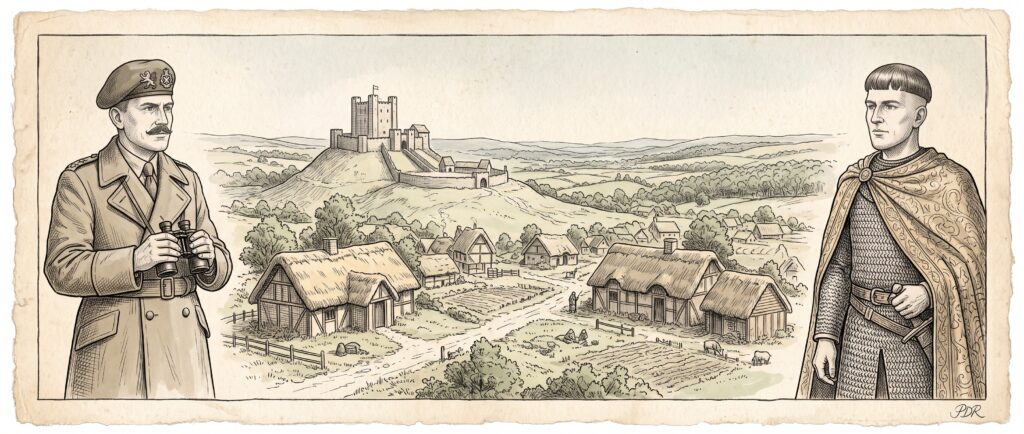
To fully evaluate Montgomery’s thesis, one must look at the man himself. Field Marshal Bernard Montgomery was not a neutral observer of medieval history; he was a proud descendant of the very Norman warlords who reshaped England in 1066.
[ Roger de Montgomery ] ──► Premier Marcher Lord & Commander at Hastings
│
▼ (900 Years of Lineage)
│
[ Field Marshal Bernard Montgomery ] ──► victor of El Alamein & Master Strategist
The Montgomery family traces its direct lineage back to Roger de Montgomery, Sieur de Montgomery in Normandy, who commanded the right flank of William’s army at the Battle of Hastings and was rewarded with vast estates across Shropshire and the Welsh border.
For a 20th-century field marshal descended from one of William the Conqueror’s top generals, it was almost second nature to view history through the lens of Norman martial exceptionalism. Montgomery was a man of iron discipline, centralised control, and methodical planning—the exact traits traditionally attributed to the Norman ruling class.
It is easy to see how a warrior of Monty’s background, looking back through nine centuries of family heritage, would see a straight line connecting his Norman ancestors’ ruthless administrative order at Hastings to the global military machine he served in the 20th century. His ancestral pride undoubtedly coloured his perspective, causing him to downplay the economic, naval, and democratic factors that truly drove imperial expansion.
The Verdict
Was Montgomery correct?
He was half-right. The Norman Conquest provided the essential institutional spine—a centralised state, a tradition of fiscal extraction, and a military model for subjugating borderlands—that made England a formidable political power capable of military projection. Without the administrative discipline forged after 1066, England might have remained a fractured, vulnerable island kingdom.
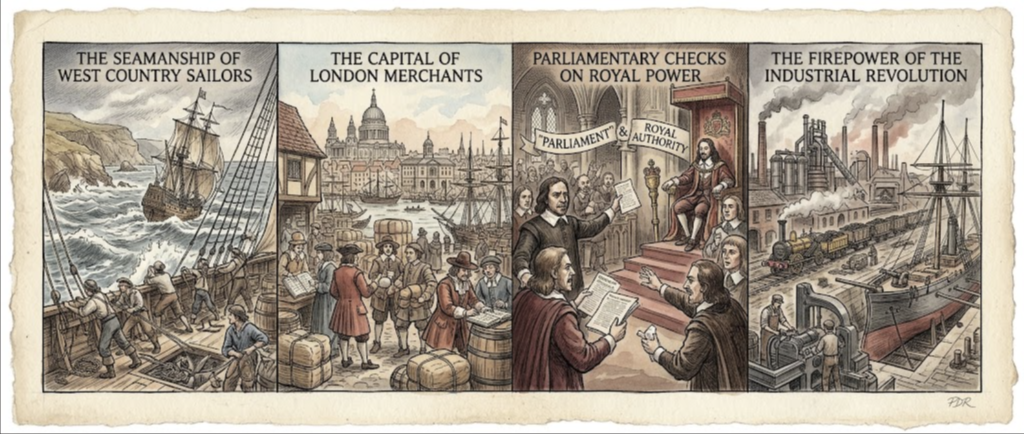
However, turning that centralised kingdom into a global empire required elements the Normans never envisioned: the seamanship of West Country sailors, the capital of London merchants, the parliamentary checks on royal power, and the sheer firepower of the Industrial Revolution.
Monty’s thesis remains a brilliant, provocative insight into military continuity, but it carries the unmistakable polish of ancestral romanticism. The Field Marshal saw the shadows of his own Norman forebears standing at the helm of the British Empire—and while they certainly laid the keystone, it took many different hands over many centuries to build the rest of the arch.