History is often written by the victors, but even the victors’ own chroniclers couldn’t hide the horror of 1069. When William the Conqueror marched north to crush a rebellion fueled by English nobles and Danish Vikings, he didn’t just seek to win a battle—he sought to delete a culture’s capacity to resist.
The resulting Harrying of the North was a systematic campaign of “total war” that left a scar across the English landscape and psyche that would take centuries to fully heal. To understand the modern divide between North and South, one must first look at the smoke rising from the 11th-century horizon.

The Immediate Apocalypse: A Decade of Silence
The strategy was brutally simple: if the North could not be ruled, it would be starved. William’s forces moved through Yorkshire and beyond, burning every crop, slaughtering every head of livestock, and smashing the very tools needed to replant the earth.
The immediate human cost was staggering. Approximately 100,000 people perished, not primarily from the sword, but from the slow, agonising grip of famine and winter. Contemporary reports described desperate refugees fleeing as far as southern England or even Scotland, while those left behind were reduced to eating horses, dogs, and—in the most harrowing accounts—the flesh of the dead.
This was not a brief military occupation; it was a decade of desolation. For ten years, the once-vibrant heart of Northumbria fell silent. The fields remained fallow, the villages empty, and the social fabric of the Anglo-Scandinavian North was shredded beyond recognition.

The Domesday Ledger: Mapping the “Waste”
The most chilling evidence of the Harrying’s legacy isn’t found in a poem, but in a tax ledger. Seventeen years after the fires were lit, William commissioned the Domesday Book of 1086. It serves as a grim census of the devastation.
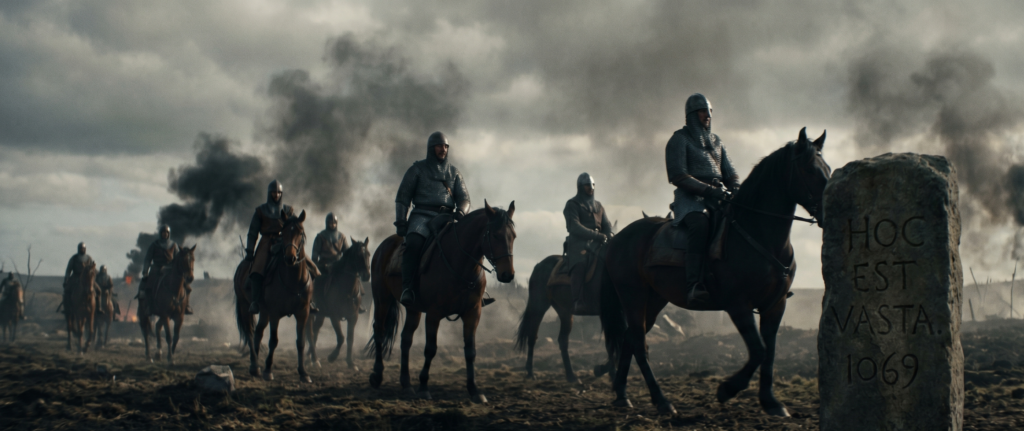
In Yorkshire, the record is repetitive and haunting. Entry after entry for formerly prosperous manors simply reads: “Hoc est vasta”—this is waste.
- Economic Collapse: Nearly 80% of Yorkshire was still recorded as “waste” almost twenty years later. This meant the land produced no tax revenue, supported no labourers, and had effectively been removed from the national economy.
- Property Devaluation: Land values in the North plummeted compared to the South, creating an economic disparity that persisted for generations.
- Demographic Shift: The depopulation allowed the Normans to eventually “re-colonise” the area with loyalists, completely altering the social hierarchy.

The Strategic Legacy: Stability through Destruction
From a cold, military perspective, William’s strategy achieved its goals. By breaking the North’s “ecosystem,” he successfully consolidated Norman power and ended the recurring threat of large-scale Anglo-Saxon uprisings.
However, the legacy of this strategy was the permanent destruction of the “Danelaw” culture. The semi-autonomous, Scandinavian-influenced identity of the North was crushed, replaced by a rigid Norman feudalism enforced by massive stone keeps like those in York and Durham. While this created a unified England on paper, it was a unity born of trauma. As we discussed in the previous article, fire can create obedience, but it cannot create a sustainable kingdom.

The Road to Recovery: A Century of Scars
How long did it take for the North to recover? If we define recovery as the return of pre-1069 population levels and economic output, the answer is measured in generations.
The North did not truly begin to breathe again until the mid-12th century. It took the arrival of the Cistercian monks in the 1130s—founding great abbeys like Rievaulx and Fountains—to bring the “waste” back into productivity. These monks were the first to successfully re-cultivate the moorlands on a massive scale, turning the scarred landscape into a powerhouse of the wool trade.
Yet, even as the sheep began to graze, the political scar remained. The Harrying established a precedent for a distant, Southern-based monarchy and government, ruling the North through force rather than consent. Was this the precedent for Westminster’s present-day power base?
Conclusion: A Kingdom Built on Ash
The legacy of the Harrying of the North is a reminder that strategic “success” often carries a price that a nation pays for centuries. William secured his crown, but in doing so, he created a fractured England.
The North eventually recovered its economic strength, but the memory of the “waste” lingers in the very soil of Yorkshire. It stands as a testament to the fact that while a conqueror can burn a field in a day, it takes a hundred years of peace or more to grow back the heart of a people.