
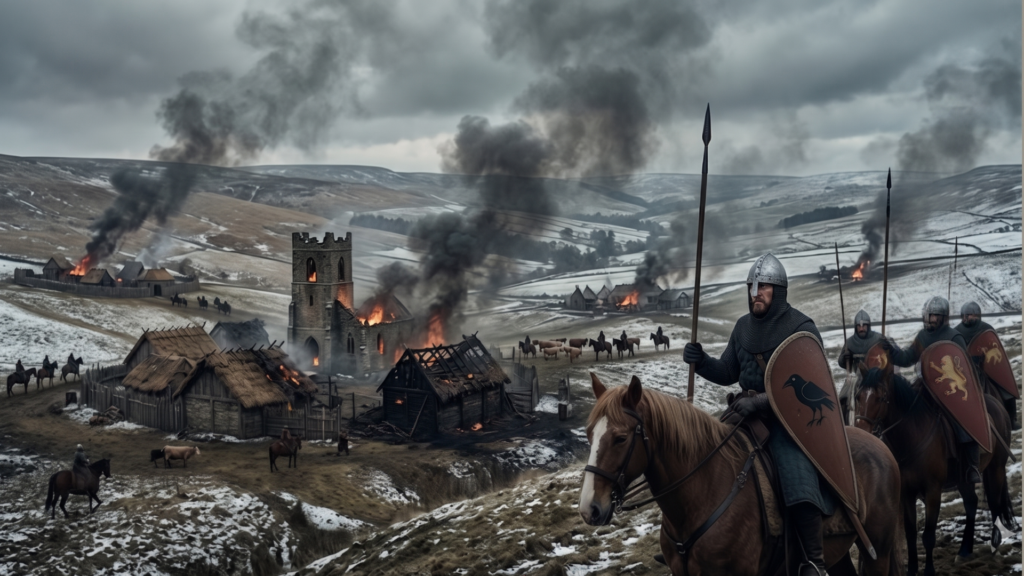
The crowning of William the Conqueror on Christmas Day, 1066, did not end the Norman Conquest; it merely signaled its bloodiest phase. While Southern England was relatively quickly pacified through a combination of brutality and castle-building, the North—comprising the ancient kingdom of Northumbria and the Danelaw—remained a stubborn bastion of resistance.
The culmination of this resistance in 1069 led William to unleash a campaign of systematic devastation known as the Harrying of the North. It remains one of the most controversial and horrifying acts of state terror in British history. Modern sensibilities rightly label it genocidal, yet to understand the conquest, we must ask a chilling question: from the Conqueror’s medieval, pragmatic perspective, was this apocalypse necessary? And, if not, what other tactics could have secured his fragile crown?
The Norman View: A Logical Apocalypse
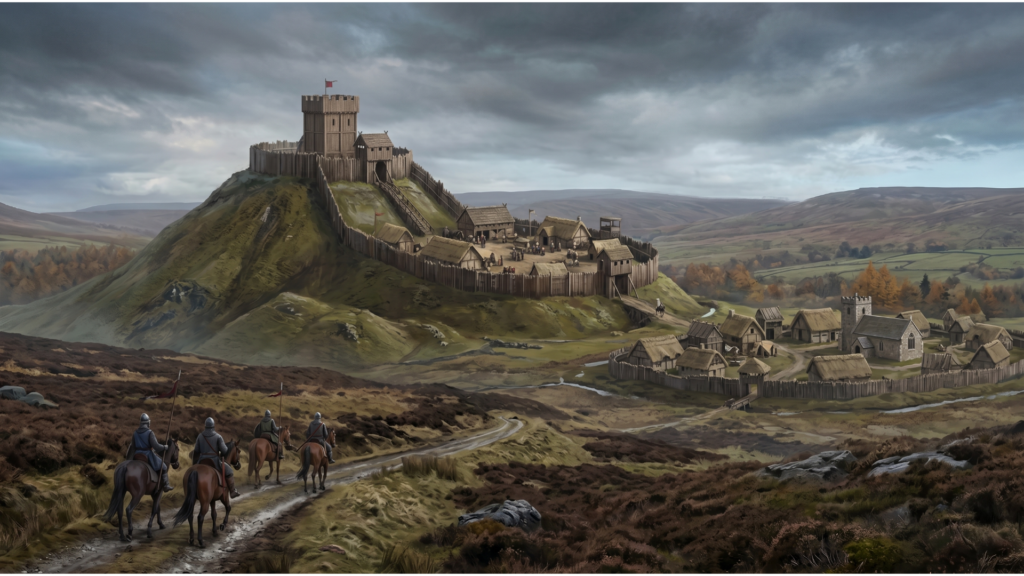
To William, the North in 1069 was not just a rebellious province; it was an existential threat. It was functionally semi-autonomous, culturally distinct due to Scandinavian influence, and served as a base for claimants like Edgar Ætheling, the grandson of Edmund Ironside. The situation became critical when Northumbrian rebels allied with a massive Danish invasion fleet that retook York, slaughtering the Norman garrison. William faced a multi-front war, difficult communications due to terrain, and a rebel army that refused to face him in open battle, opting for guerrilla tactics.
In this context, the Harrying was an horrific but calculated military decision. Orderic Vitalis, an Anglo-Norman chronicler writing fifty years later, described the result as “a fertile land… ravaged by fire and sword, and utterly desolated.” By burning crops, slaughtering livestock, and destroying tools from the Humber to the Tees, William wasn’t just punishing rebels; he was eliminating the region’s capacity to sustain an army—whether English, Danish, or Scottish—for a generation. He was breaking the spirit of the people alongside their bodies.
While Orderic called it a “stain upon his soul,” from a cold, strategic viewpoint, it worked. The Domesday Book of 1086—nearly twenty years later—still recorded vast swathes of Yorkshire as “waste.” There were no further major Anglo-Saxon uprisings in the North for the remainder of William’s reign. The Harrying, therefore, achieved its goal: the consolidation of Norman power through the total destruction of the opposition’s ecosystem.
Alternatives to Annihilation
However, stating that it “worked” does not mean it was the only option. Other pacification tactics, though perhaps slower or more costly in treasure, could have achieved the same aim of long-term security without annihilating the civilian population.
1. Advanced Castle Stewardship
The Normans were masters of castle-building, using them to police territory with small, efficient garrisons. While castles were built in York and Durham prior to 1069, they were insufficient. A more intensive “castle-centric” stewardship model could have been deployed earlier. Rather than waiting for full rebellions, William could have established a dense network of motte-and-bailey castles across Northumbria immediately, effectively dividing the region and preventing rebels from mobilizing large forces.
2. Marcher Earldoms and Buffer Zones
Similar to how he structured the Welsh borders, William could have created powerful “Marcher” earldoms in the North. He could have granted almost regal powers to ruthless Norman lords (or, ideally, Sympathetic English ones, if any remained) who had a direct mandate to pacify their territories through localized military action and diplomacy. These earldoms would act as autonomous buffer zones against Scottish and Danish interference, concentrating local control rather than relying on the king’s personal presence.
3. Diplomatic and Economic Isolation
The North rebellions relied heavily on Danish support and Scottish sanctuary. William already knew bribery worked; he successfully paid the Danish fleet to depart in the winter of 1069 after the Harrying began. A more sophisticated tactic would have been to bribe the Danes earlier and more extensively, coupled with diplomatic pressure on Malcolm III of Scotland to isolate Edgar Ætheling. Economically isolating rebel hubs like York through Norman-controlled trade routes could have weakened resistance without causing region-wide famine.
Conclusion
The Harrying of the North was a medieval tragedy born of strategic anxiety. It was not necessary in the absolute sense; alternative methods existed that prioritized localised control, strategic architecture, and diplomacy. William, however, chose state terror. While he achieved the short-term goal of pacification, he did so at an unacceptable moral and human cost. The 100,000 deaths from starvation and the subsequent decade of desolation stand as a testament to the fact that while fire can create obedience, it cannot create a sustainable kingdom.



This Post Has 2 Comments
This is very interesting. So, he did have options, but maybe the word “anxiety” offers an explanation as to why he went full genocidal. William was so paranoid and anxious after Hastings, he mistook some mundane local activity during his coronation as rebellion. Three years later he was still in the early days of managing an unfamiliar country and culture. This isn’t an excuse, just maybe an explanation. I understand that in his later years he expressed regret for the harrying?
I think he ran out of patience with the English population. They would never lie down as he wished despite his overwhelming use of force. He never really liked England – as evidenced by his return to Normandy shortly after his coronation and when he returned he just wanted it finished by fair means or foul. By our modern standards the Harrying was a brutal decision but to a medieval dictator, Christian or not. In William’s mind the end probably justified the means.