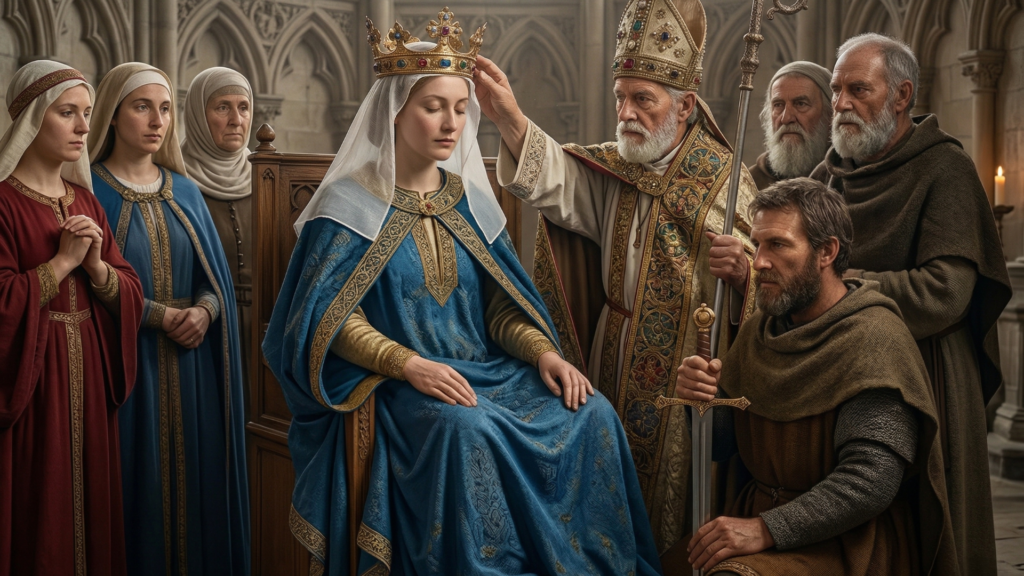
We know his name: William the Conqueror. We know the date: 1066. We know the outcome: The Battle of Hastings and the start of Norman England. But history often remembers the man on the horseback while forgetting the architect in the castle. William’s legacy as a king would never have been solidified—perhaps never even begun—without the intelligence, wealth, and unwavering administrative power of his wife, Mathilda of Flanders. Mathilda was not simply a consort; she was a ruling equal who played a critical, logistical, and diplomatic role in helping William obtain the English throne.
A Lineage Worthy of a King
Born around 1031, Mathilda was the daughter of Baldwin V, Count of Flanders, one of the most powerful rulers in Europe, and Adela of France, herself the daughter of a king. Mathilda’s lineage was impeccable, bringing prestige to any alliance. By contrast, William’s start was precarious. As the illegitimate son of Duke Robert I of Normandy, his hold on his duchy was unstable, marked by rebellion from a young age. He needed a marriage that would legitimise his rule and secure his borders. Mathilda of Flanders was the ideal prize.Their initial courtship is legendary, albeit likely exaggerated. Stories claim she refused him, horrified at the prospect of marrying a bastard. William, in a fit of fiery resolve, reportedly rode to Flanders, dragged her by her hair, and threw her in the mud to prove his worth. While this tale of “rough wooing” is probably Norman propaganda designed to emphasize William’s implacable will, the truth is that their final union, around 1051, was a masterstroke of diplomacy. Mathilda’s powerful family connections provided William with vital security, allowing him to focus on consolidating his power within Normandy.

Architecture as Diplomacy: The Great Penance
While Mathilda provided the ships and the stability for the conquest, her most enduring physical legacy remains the “Great Penance” in the city of Caen.When William and Mathilda married around 1051, they did so in open defiance of the Church. Pope Leo IX had formally prohibited the union at the Council of Reims, citing “consanguinity” (they were distant cousins). For years, the couple lived under the shadow of a papal ban, their children’s legitimacy technically in question—a dangerous position for a rising Duke.To reconcile with Rome and secure the spiritual foundation of their dynasty, the couple struck a deal with the Papacy. The price of their “sinful” union? A massive building program.
Mathilda and William didn’t just build small chapels; they transformed Caen into a spiritual powerhouse by founding two of the most significant Romanesque structures in Europe:
- Abbaye aux Dames (The Abbey of Queens): Founded by Mathilda in 1060, the Church of the Holy Trinity was her personal project. It was a Benedictine nunnery designed to house the daughters of the nobility and serve as a monument to her devotion.
- Abbaye aux Hommes (The Abbey of Kings): Simultaneously, William founded St. Stephen’s.

The Ship that Launched the Conquest
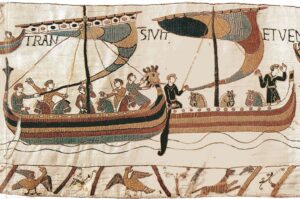
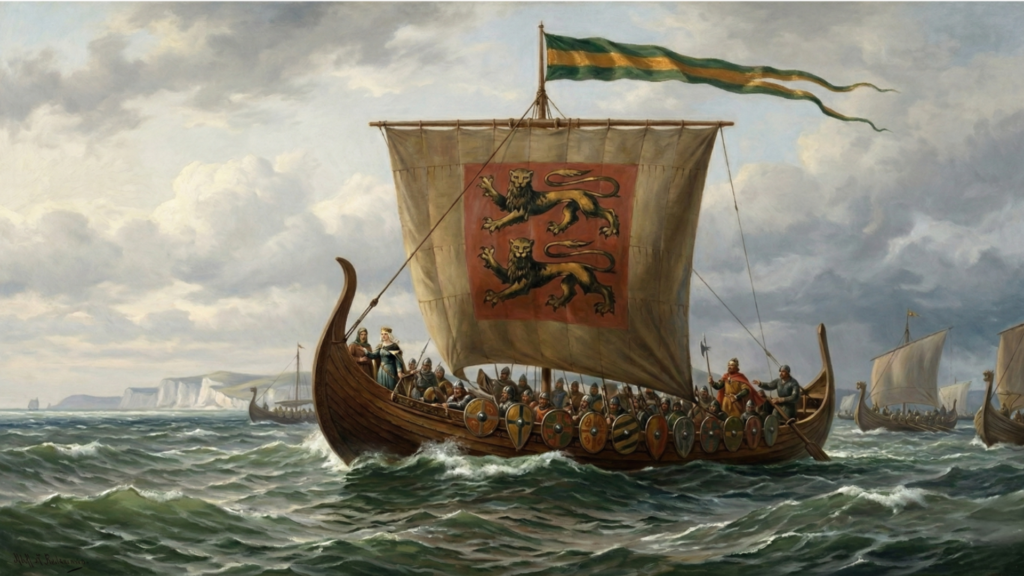
In 1066, when William made his claim to the English throne, he faced a colossal logistical challenge: he needed to transport an entire army, their horses, and supplies across the English Channel. It was an invasion on a scale rarely seen, and it required immense resources.Mathilda did not merely offer moral support; she provided the means. Out of her own personal funds, she commissioned the flagship of William’s invasion fleet. It was a magnificent ship named the Mora.
The Mora was reportedly the largest and fastest vessel in the fleet, a true longship of the Drakkar design. It was adorned with a golden child figurehead pointing toward England, carrying a trumpet. By gifting this vessel, Mathilda not only solved a major logistical hurdle but also made a powerful public statement of belief in her husband’s claim. Her financial investment was a direct contribution to the success of the invasion.
The True Ruler of Normandy
Mathilda’s most significant role in William’s conquest, however, was what she did in his absence. When William set sail for England in September 1066, he left Normandy—his home, his power base, and a duchy still prone to rebellion—entirely in her hands.
Mathilda was appointed Regent of Normandy. This was not a ceremonial title. She was given full authority to make laws, levy taxes, and dispense justice. For more than a year, as William fought his war of conquest at Hastings and scrambled to secure England, Mathilda governed Normandy.
She did so successfully. There were no major uprisings. She guided the duchy through this critical period in the name of their young son, Robert Curthose, demonstrating profound administrative skill. Without her capability to maintain peace and collect the revenue needed to fund William’s ongoing war, his English campaign could have easily collapsed from within.
Mathilda’s success as a ruler proved her ability to wield power as a peer. Her visibility as a consort who could effectively travel, preside over courts, and witness charters ensured that the authority of the ducal house remained unquestioned across both sides of the Channel.
A Partnership for the Ages
In April 1068, after William had secured his initial hold on England, Mathilda crossed the Channel to join him. She was crowned Queen of England in an elaborate ceremony, emphasising her legitimate right to rule alongside him. She became a visibly active queen, continuing to serve as regent in both England and Normandy multiple times over the next decade.