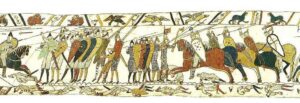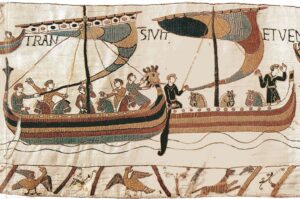
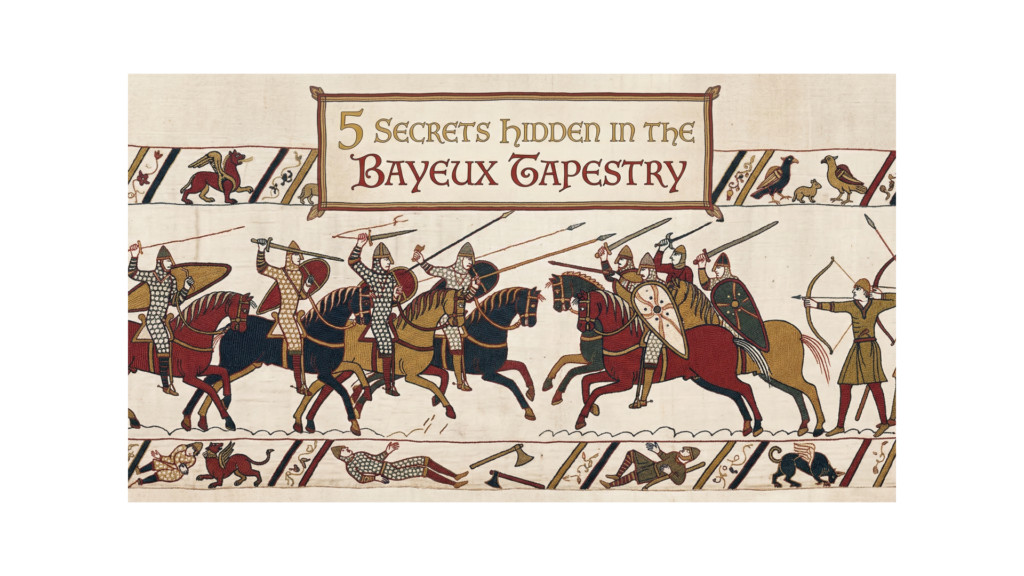
The Bayeux Tapestry is perhaps the world’s most famous “comic strip.” Stretching nearly 70 metres, it tells the epic saga of the Norman Conquest of 1066. But look closer at the hand-stitched linen, and you’ll find it isn’t just a record of William the Conqueror’s victory—it’s a landscape of hidden scandals, political propaganda, and subversive “Easter eggs.”If you’re visiting the tapestry (or just admiring it from afar), here are the top five secrets hidden within its threads.
1. The Mystery of Ælfgyva
In a work dominated by men and soldiers, only three women appear in the main narrative. One stands out: Ælfgyva. She is the only woman named, yet her scene is baffling. A “certain cleric” reaches out to touch her face while a naked, well-endowed man mimics the cleric’s pose in the margin below.
What it (probably) means: Most historians believe this depicts a well-known contemporary sex scandal that the audience of 1067 would have instantly recognized. By including it, the designers likely aimed to discredit a specific noble family or highlight the moral “corruption” of the English court.
2. The “Arrow in the Eye” may be a Lie
The most iconic image in English history is King Harold clutching an arrow in his eye. However, look at the stitching. There is evidence that the arrow was a later addition or a repair.
What it (probably) means: Early accounts of the battle don’t mention the arrow; they say Harold was hacked to pieces (which is what the figure next to him is experiencing). The “arrow in the eye” was a medieval metaphor for the death of a perjurer. Since the Normans claimed Harold broke a holy oath, they likely “edited” his death to show divine justice in action.
3. Subversive Stories in the Margins
The top and bottom borders are filled with strange creatures and scenes from Aesop’s Fables, such as The Fox and the Crow.
Why they are (probably) there: While the main panels tell the “official” Norman story, the margins—likely designed by English embroiderers—tell a different tale. Many of these fables focus on deceit and the illegal possession of goods. It’s widely thought the English needleworkers were using these stories to subtly mock their new Norman masters, calling them thieves and liars right under their noses.
4. The First Sighting of Halley’s Comet
Long before astronomers understood the cosmos, the tapestry captured a “hairy star” streaking across the sky. This is the earliest known visual depiction of Halley’s Comet, which appeared in April 1066.
What it (probably) means: In the medieval mind, comets were terrifying omens. The tapestry shows the English looking up in dread, while the Latin text reads “They marvel at the star.” For the Normans, it was proof that God had marked Harold for doom months before the battle even began.
5. Is it Actually a Tapestry?
This is the ultimate secret: the Bayeux Tapestry is a lie by definition. A true tapestry is woven into the fabric on a loom.
What it (possibly) means: This is actually an embroidery, stitched onto the linen with wool. It was likely made in Canterbury, England, not France. Calling it a tapestry was a 15th-century naming error that simply stuck for 500 years!