The Norman warrior who charged up Senlac Hill in 1066, armoured on horseback, cut a figure vastly different from his Viking ancestors who had ravaged European coastlines centuries earlier. Yet, beneath the chainmail and behind the conical helmet lay a profound, and still detectable, Norse inheritance. The conquest of Normandy by Rollo and his Northmen in the early 10th century set in motion a unique blending of cultures, creating a society that, by the mid-11th century, was distinctively Norman but still intrinsically Viking in key ways. What traces of their Norse heritage did these Norman warriors retain on the eve of their epochal invasion of England?
The most obvious trace, of course, was ancestral and dynastic. The Norman aristocracy was, at its core, the direct descendants of the Viking warriors who had taken control of Neustria. William the Conqueror himself was a direct descendant of Rollo. This was not merely an historical curiosity; it was a defining characteristic of the Norman ruling class. Their claim to power and their warlike prowess was tied directly to their Norse bloodline.
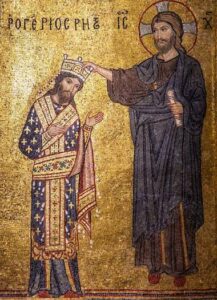
Furthermore, this lineage fostered a persistent, restless energy and an aggressive military spirit. The chroniclers of the time often remarked on the “Norman character” as one marked by ambition, courage, and a love of warfare – traits undeniably inherited from their Viking forebears. This spirit was not directed inward, as in many Viking territories, but was instead channeled outwards, fueled by a unique mix of Viking ambition and Frankish sophistication. It was this same dynamic, aggressive spirit that would later fuel Norman expansion into Italy and the creation of the Kingdom of Sicily, as well as the initial crusading impulse.
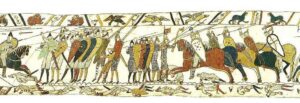
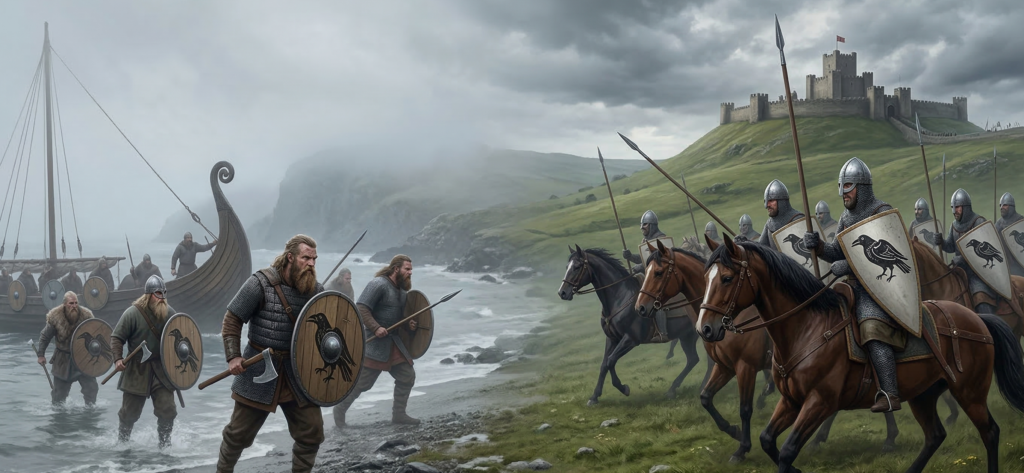
Visually, there were tangible connections. The chainmail hauberk worn by the Norman warrior, while sophisticated for the time, was a direct development of the simpler mail coats used by earlier Vikings. The conical helmet with its distinctive nasal guard, famously depicted on the Bayeux Tapestry, was a design widely used by both Norsemen and Franks. The fearsome two-handed Danish axe, synonymous with Viking warriors, was still a weapon utilised by Norman knights and foot soldiers, albeit alongside the cavalry lance and one-handed sword.
Perhaps most significantly, the Norman cavalry charge itself, a tactical innovation for which they are famous, had its origins in a unique cultural fusion. While early Vikings were not traditionally cavalrymen, they quickly adapted and incorporated horses into their military repertoire. In Normandy, this tendency fused with the well-established Frankish tradition of heavy cavalry. The result was the distinctively Norman heavy cavalry charge, which would play a decisive role at the Battle of Hastings and become a staple of medieval European warfare for centuries to come.
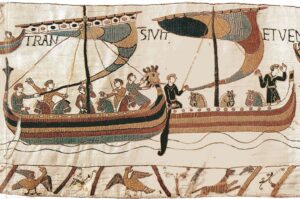
Yet, despite these retained traces, the Norman warrior of 1066 was vastly different from his Viking ancestor. He was not a maritime raider, but a landed lord. His power-base was not a fleet of longships, but a castle and a carefully organised feudal estate. He was Christian, not pagan, and his worldview was shaped by the church, feudal obligations, and a centralized ducal authority unknown to earlier Vikings. Their ships were no longer the primary instrument of warfare, as evidenced by William’s need to build a fleet from scratch for the invasion of England.
This shift was driven by the rapid and profound cultural assimilation that occurred in Normandy. The Northmen did not merely conquer; they integrated. They adopted the French language, the Frankish feudal system, and, crucially, the Christian faith. The Norsemen in Normandy became the “Normans” – a distinct people with a rich, hybrid culture. They retained the fierce military prowess and aggressive spirit of their Viking ancestors but molded it with the sophistication and order of the Carolingian and Capetian worlds.
In conclusion, the Norman warrior of 1066 was a complex, hybrid figure. While he was outwardly a sophisticated, heavily armored cavalryman, deeply embedded in the feudal and Christian culture of northern France, he nonetheless retained significant traces of his Norse heritage. His very lineage, his aggressive martial spirit, key elements of his gear and tactics, and even his persistent ambition were all direct inheritances from his Viking forebears. The Battle of Hastings was not just a clash between Saxons and Normans; it was, in a very real sense, a dramatic collision involving a people who were, at one and the same time, sophisticated French knights and fierce sons of the North. The story of the Normans is, fundamentally, a story of successful integration and the enduring power of ancestral identity, even as it adapts and thrives in a changing world.