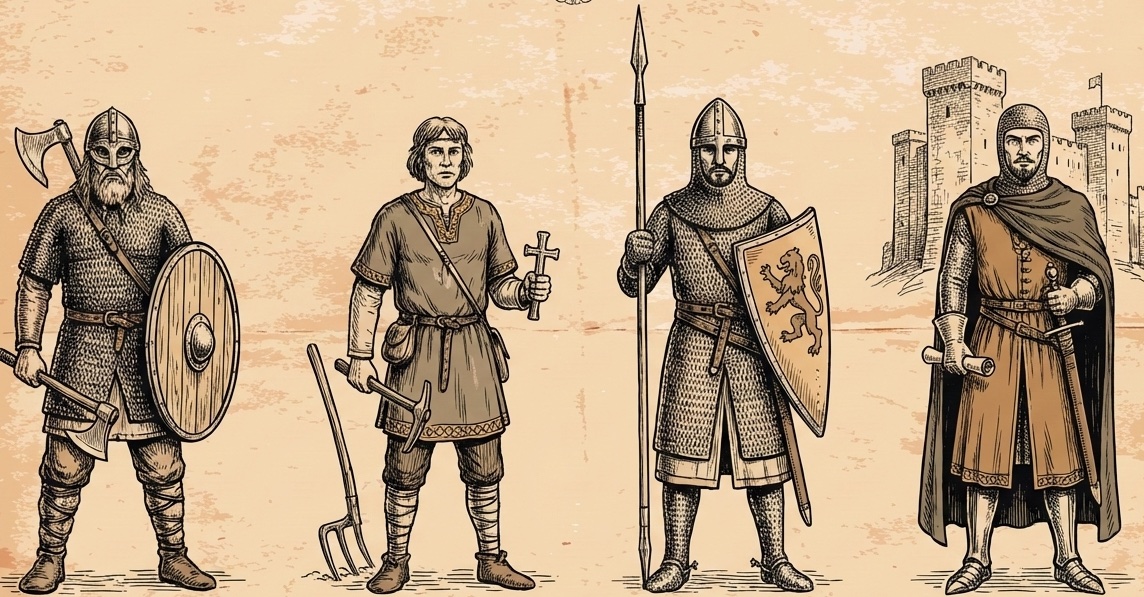
In the year 911 AD, the land we now call Normandy was simply “Neustria”—a fractured, raid-weary province of the West Frankish Kingdom. Its new masters were “Northmen,” pagan warriors who had spent decades pulling wealth out of the Seine. Yet, less than a century later, these same men were the most fervent Christians, the most disciplined administrators, and the most elite heavy cavalry in Europe. How did a Viking warband become a French-speaking aristocracy in just three generations? Let’s look at the milestones of this cultural “speed-run.”The transformation began not with a battle, but with a signature. When the Viking leader Rollo met King Charles the Simple, he accepted a bargain: land in exchange for a “buffer zone” against other Vikings.This was the first and most vital milestone. Unlike the Vikings in Brittany, who remained outsiders, Rollo accepted the legal framework of the Frankish world. He didn’t just occupy the land; he became its legitimate protector.
Religion was the 10th-century “software update.” By accepting baptism and taking the name Robert, Rollo signaled to the local Gallo-Roman population and the powerful Catholic Church that the Vikings were here to stay as partners, not predators. This allowed the “Brain Trust” of the Frankish world—the bishops and monks—to return and begin rebuilding the administrative machinery of the state.
Rollo’s son, William Longsword, represents the critical “second generation” milestone. While his father was a Viking who learned to be a Lord, William was a Lord who happened to have Viking ancestry.His reign saw the rapid adoption of the French language in the capital of Rouen. While Old Norse was still spoken in the coastal pockets (like Bayeux), the court was becoming culturally French. When William was assassinated in 942, the “Norman” identity was tested by fire—and it held. The Norsemen didn’t flee; they stood their ground as a political unit.
By the time of Richard I (the Fearless), the transformation was nearly complete. In 966, Richard invited Benedictine monks to Mont-Saint-Michel. This milestone is symbolic: the very people who had once fled Viking longships were now being invited back to build the greatest monuments of the Norman spirit. The “Norsemen of Neustria” were now the “Normans of Normandy.” By the early 11th century, the transition from sea-power to land-power was finalized. The Normans had traded the longship for the destrier (the warhorse). They had perfected the “motte and bailey” castle and established a legal system so efficient it would eventually be exported to England, Sicily, and Antioc
The “Norman Miracle” happened because the Norsemen of Normandy were pragmatists. They realized that to keep the land, they had to become part of the land. In Brittany, the Vikings remained “The Other” and were eventually expelled. In Normandy, they became the elite, ensuring their survival by disappearing into the culture they had once conquered.
Today, we don’t find many Viking runes in Normandy—we find cathedrals. That is the ultimate proof of their success.