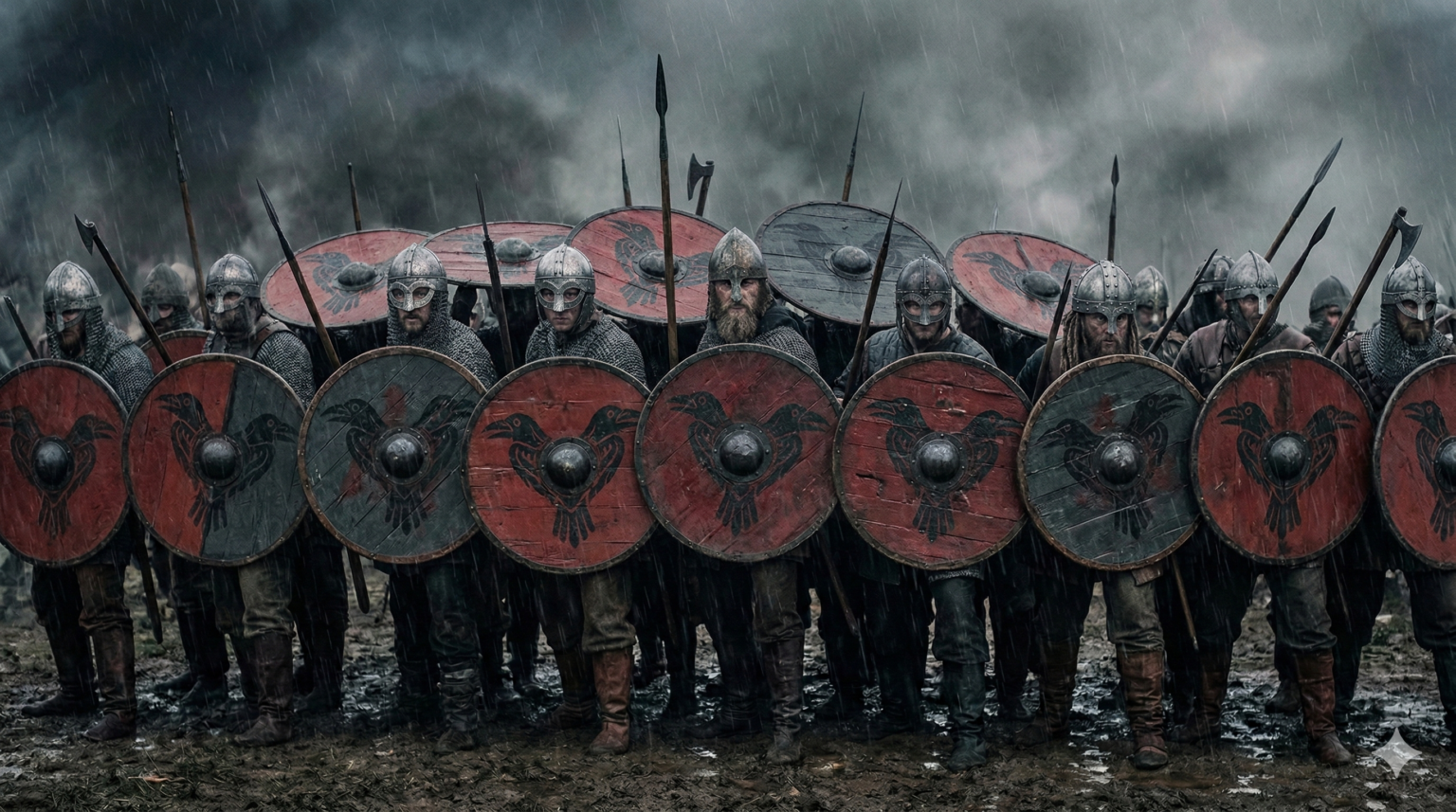
There was nothing remotely romantic about standing in a medieval shieldwall, it was simply a highly efficient expedient to winning medieval battles, To the modern observer, the most important component i.e. the shield, was a defensive tool. To a 10th-century warrior like Bjorn ‘Speararm’ Halfdanson, the shieldwall was a part of an offensive and defensive killing machine. The skjaldborg in old Norse, was not merely a line of tightly packed armed men; it was a sophisticated exercise in physics, psychology, and collective survival.
The “science” of the shieldwall relied on the overlapping of linden-wood or oak shields. By placing the edge of your shield over the mid-point of the man to your left, you created a continuous barrier of timber and iron. This formation transformed individual warriors into a single, massive force multiplier. When an enemy charged, the kinetic energy of the impact was distributed across the entire line. The shield was used as a lever—by angling the face slightly, a warrior could deflect the linear force of a spear-thrust into a tangential one, turning a killing blow into a harmless slide.
Standing in a shieldwall was not for the faint-hearted, it was a sensory assault. It was not the clean, cinematic affair seen in movies. It was a “crush” and the reek of men defecating in fear and of butchered bodies must have been overpowering You were packed so tightly that you could inhale the stale ale and sweat of your kinsmen. Your vision was reduced to a thin horizontal slit between the rims of the shields.
The sound was a rhythmic drumming—the thrum-clack of axes, arrows and spears hitting wood—and the “iron pulse” of your own heart racing in your ears. You didn’t fight with your eyes as much as your shoulders, leaning into the man in front of you to prevent the line from buckling under the weight of the enemy’s “push.” Your own weapon, most probably a spear or a seax had to be thrust at the enemy through any gap in the wall whilst your fellow axemen might hew away from above or from the supporting ranks behind in a effort to dislodge enemy shields thus creating weak points in the lines of their foeman
Pros and Cons of the Skjaldborg
The Pros:
- Unbeatable Defense: Against infantry and archers, a well-set medieval wall was nearly impenetrable.
- Psychological Anchor: There is safety in the herd. A warrior who might flee alone will stand his ground when locked into a line of his brothers
- Reinforced by bonds of kinsmanship: the warriors, making up the componentry of the shieldwall were often blood-related and standing next to a kinsman whose allegiance was to his clan, above all else, was a fierce motivational factor.
The Cons:
- Immobility: The formation was slow. Turning or retreating required immense discipline; once the “lock” was broken, the men were vulnerable.
- Vunerability of the flanks: the longer the wall, the more chance there was of collapse. Once any exposed flanks began to buckle and ‘roll-up’, a ripple effect could be felt all along the line.
- Exhaustion: Holding a thirty-pound shield at head-height while being pushed by five hundred pounds of enemy muscle was physically draining.
- Heavy cavalry vs infantry created inequality : Once cavalry were deployed against a shieldwall, not matter how robust, it could lose integrity. When several tons of Frankish horse and rider were pitted against standing men, something was always going to give – particularly on any exposed flanks.
The Turning Point: The Battle of Hastings (1066)
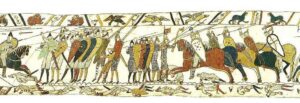
The greatest medieval shieldwall battle was undoubtedly the Battle of Hastings. On October 14, 1066, King Harold’s Saxon army held the ridge at Senlac Hill, forming a shieldwall so dense that the dead were said to remain standing because there was no room to fall.
For hours, the Saxon wall withstood the superior cavalry and archers of William the Conqueror. The formation only failed when the Saxons broke their own line to pursue “fleeing” Normans—a feigned retreat orchestrated by Duke William. Once the shield-lock was shattered, the individual Saxons were cut down. The outcome changed the course of history and along with Harald Hardrada’s defeat at Stamford Bridge, earlier in the year, the Viking Age in England came to an abrupt halt, beginning the new era of the Normans.