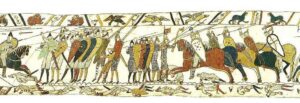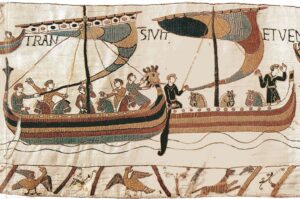
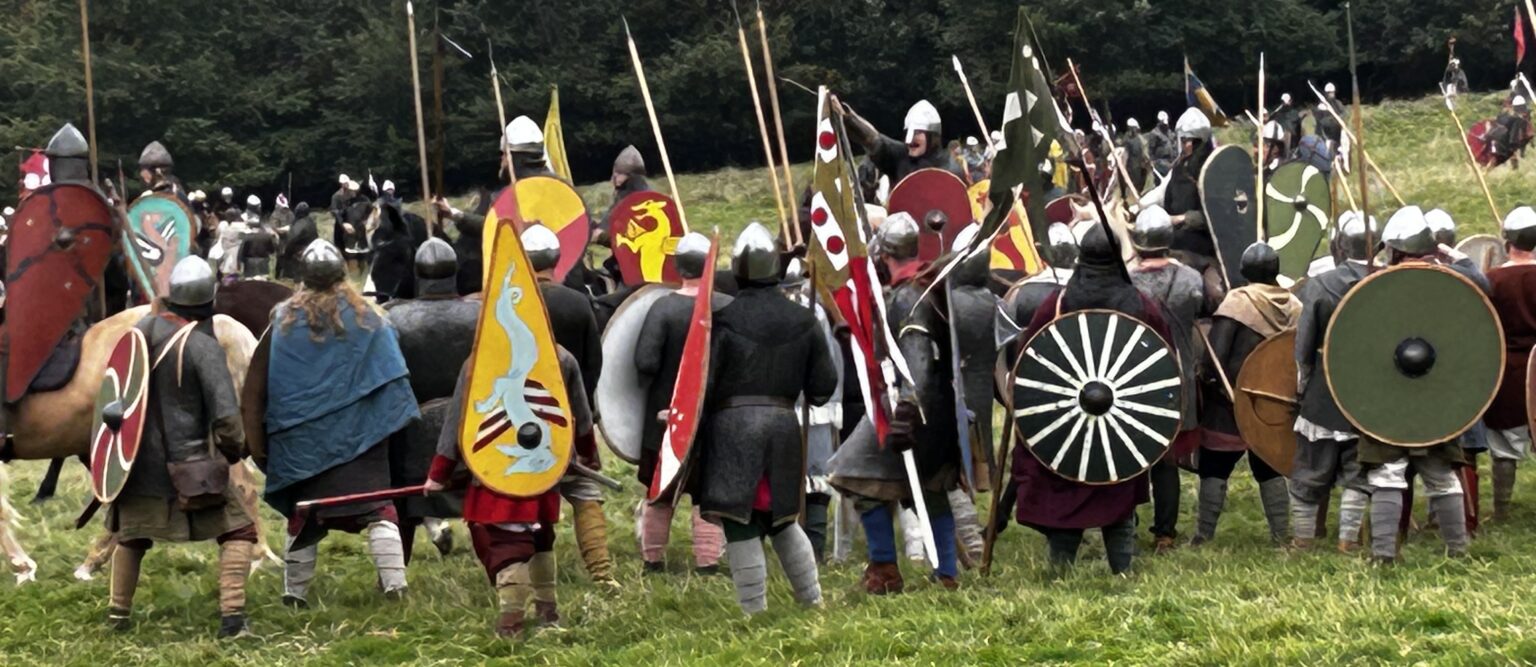
After attending a recent enactment at Battle Abbey, I was reminded of the old Irish saying, “If ifs and buts were pots and pans, they’d be no need for tinkers’ hands.” I wondered what might have been, had Harold Godwinson not fallen, what would have happened to Saxon England post-1066, and, as importantly, what would have been the destiny of Normandy? Had the winds of fate not been so kind to Duke William, what would the eventual outcome have been?
Apart from anything else, 1066 was an extraordinary year in England with three decisive battles occurring within weeks of each other. If Harald had not been quite so impetuous and listened to the advice of his brothers to wait in London for reinforcements before marching off to Senlac Hill and destruction, would things have worked out differently?
Well, for a start, 90% of the Saxon aristocracy that disappeared would have remained in situ. England’s sophisticated structure, including the Witan, the shire courts, the fyrd, and a standardised tax system, arguably the most advanced in Europe, would not have changed. Without the hostile Norman takeover, the country might have continued evolving at its own pace, maintaining a more decentralised and efficient form of governance than the simpler feudal system imposed on a conquered population. There would, doubtless, have been less feudal fragmentation with the old system and the subsequent ‘land grab’ where the Norman Barons replaced the Saxon Earls, and everything beneath them and the ‘process change’ would simply not have occurred. A Godwinson victory might have preserved a system somewhat closer to the Scandinavian model with ruling Earls and landed thegns unbound by rigid hierarchies. With the resultant local autonomy, there would surely have been a slower uptake of aristocratic power given that the people would not have been at the mercy of the greedy Norman baronnies.
As did the Vikings before them, the Normans flooded England with ‘foreign’ vocabulary and court culture, creating the Anglo-Norman hybrid we know today. Without it, Old English might have developed more naturally into a language resembling modern Frisian or Dutch—still Germanic, with far fewer Romance influences. The 1.35 billion English speakers in today’s world could well have had a completely different lexicon of words to choose from. Culturally, England might have retained stronger ties to its Scandinavian neighbours, influencing law, art, architecture, military planning and seafaring tradition.
Duke William’s victory, sanctioned and blessed by the Holy See, brought tighter Papal influence. Indeed, the threat of excommunication to Harald Godwinson, when he lived, and the Papal Blessing of William the Conqueror was a telling factor in the conflict. Continued Anglo-Saxon rule might well have kept the English Church semi-autonomous and more in line with earlier Celtic traditions. A medieval Christian clergy without the influence of Rome might well have caused a major schism.
It is not known if Harald had any designs on building an empire, but if he did, he would probably have looked North to Scandinavia rather than across the Narrow Sea. Closer ties with Denmark or Norway might have created a powerful North Sea realm—one that would dominate Baltic trade centuries before the Hanseatic League grew to such importance.
The conquest took its toll on both William and the Duchy, but such was the reward in winning England that, in the short term, it was deemed worthwhile. The new King was probably overwhelmed by the effort, and he left for home early in 1067, leaving the country in the control of his even more aggressive half-brother, Odo of Bayeux. Subsequent generations of Norman rulers were similarly drained and must have wondered whether it was all worth it. To rule effectively in two countries took a massive effort. If William had failed, Normandy might have remained stable, avoiding entanglement in English politics and the troublesome Channel-spanning empire that later collapsed with King John into the Angevin disaster. Eventually, the Norman kings of England became rivals of the French crown, leading to centuries of warfare and culminating in the Hundred Years’ War. Without the conquest, Normandy might have remained a loyal and prosperous duchy owing fealty to the French realm, benefiting from trade rather than enduring centuries of Anglo-French conflict.
Before 1066, the Duchy of Normandy was very dynamic – part Viking, part Frankish, part Gallo-romano but highly commercially minded and mercantile. A failed invasion could have led to a cultural golden age that focused on architecture, maritime trade, and continental influence rather than constant and debilitating conflict. The Norman military machine, in the manner of the Roman legions, might have endured, paving the way to greater and even more significant victories.
The absence of a Norman dynasty in England would have meant no Plantagenets, no Angevin Empire, no English claim to the French throne—and probably no Hundred Years’ War. The English Channel that brought such destruction in 1066 might have remained a cultural bridge instead of a centuries-long battleground.