
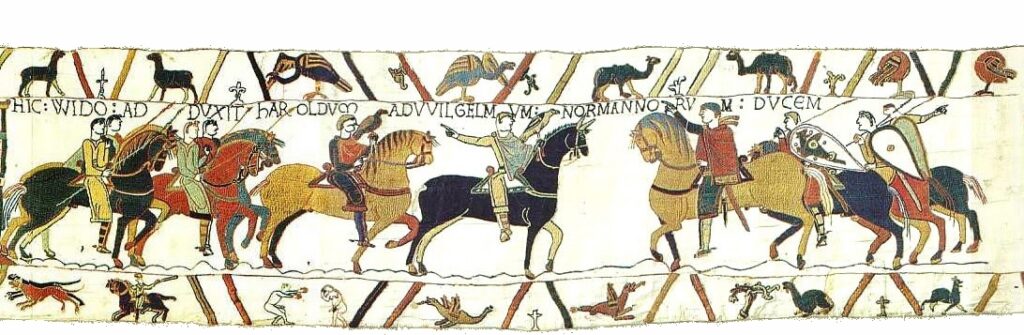
The end of 1066 marked a significant and historical turning point and was characterised by three major battles. The King of Norway fell at Stamford Bridge, along with over 10,000 of his warriors, signalling the conclusion of the ‘Age of the Vikings.’ King Harold of the Saxons faced a similar fate at the Battle of Hastings, where he was carried from the field in pieces, along with the hopes and dreams of his people. Following the Norman Conquest in 1066, the Saxons—especially the nobility—faced devastation. The fate of the Saxon people unfolded as follows:
A Hostile Takeover: William I, also known as “William the Conqueror,” became king and was crowned in Westminster after his victory. The new king embarked on a systematic campaign to consolidate his power, beginning with the confiscation and redistribution of land and property. The Saxons, unwilling to accept Norman rule, revolted, prompting King William to suppress uprisings and resistance with brutal force. His methods included actions such as the Harrying of the North (1069–1070), which resulted in widespread devastation and famine in northern England.
A New Feudal System: The Normans introduced their own version of feudalism in England, redistributing land to William’s supporters and allies, many of whom were French-speaking Normans. This initiative resulted in Saxon lords losing over 95% of their wealth, leading many to flee abroad to become mercenaries. The surviving Saxon earls, who were neither killed in battle nor executed, were generally stripped of their estates. King William rewarded the Norman elite with large portions of confiscated land, granting them as fiefs under his overlordship.
Anglo-Saxon Earldom: The surviving Saxon nobles were compelled to swear fealty and submit to William. Many faced exile, while some managed to retain their lands, albeit by renouncing their previous loyalties, adopting Norman customs, language, and intermarrying with Norman noblewomen. Over time, the English aristocracy became assimilated into the Norman system, with many formerly powerful Anglo-Saxon families losing their influence.
Saxon Commoners: For most common folk, such as serfs and peasants, life under Norman rule did not change immediately. They continued to toil and struggle in hard conditions, working the land for their new Norman lords. However, they soon faced increased taxation and stricter demands. As time went on, the Norman rulers endeavoured to standardise laws and taxation, causing many Saxon traditions to fade under the new centralized governance.
Cultural and Language Shift: The Normans introduced their language—Old French—which gradually blended with Old English over the years. Consequently, the Saxon language began to disappear. In the following centuries, French-influenced English vocabulary increasingly entered common usage, especially in legal, governmental, and artistic contexts. The language of government, law, and the royal court became exclusively French, leaving little room for other languages.
Rebellions and Resistance: Several rebellions occurred among the Saxons, the most notable being the uprising of 1069, which included the Harrying of the North. Despite their efforts, the Saxons faced brutal crackdowns and massacres, leading to the destruction of entire villages. Ultimately, the Saxons were defeated and pacified. In the aftermath of 1066, the Saxons were displaced from positions of power and dispossessed of their lands. Their culture and language diminished significantly, leaving little behind under the new rulers. The Saxon identity persisted among the peasantry and in regional customs, but the political and military elite were largely replaced by Norman overlords, resulting in a substantial cultural transformation.



This Post Has 2 Comments
Aenglishe spraece ne fordwyned. Saxon speech did not disappear. It dwindled in the 13th Century , up until 1250 Saxon is still standing. There is no such thing as a ,,blend ” between French and Saxon.
English was perverted by loads of Latin words that were foisted on the English by ,, education “
Thanks for your comments, Eric. You make a good point on the timeline — Old English certainly put up a centuries-long fight before fully morphing into Middle English. Where linguists might disagree is the ‘blend’ part. English has always been less of a pure lineage and more of a language that chases other languages down dark alleys to rifle through their pockets for spare vocabulary. Norman French gave us our legal, administrative, and culinary words, while Latin gave us our academic terms. Without that mashup, we’d be living in a very different world—though I do agree there’s a crisp, honest magic to pure Anglo-Saxon speech.