Viking history is as extensive as the people it studies. The settlement of Normandy during the four hundred centuries of their ‘golden age’ was no less than extraordinary. The conversion of this company, from nomadic Scandinavian raiders into all-conquering Normans had far-reaching effects on medieval Europe.
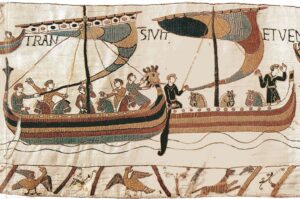
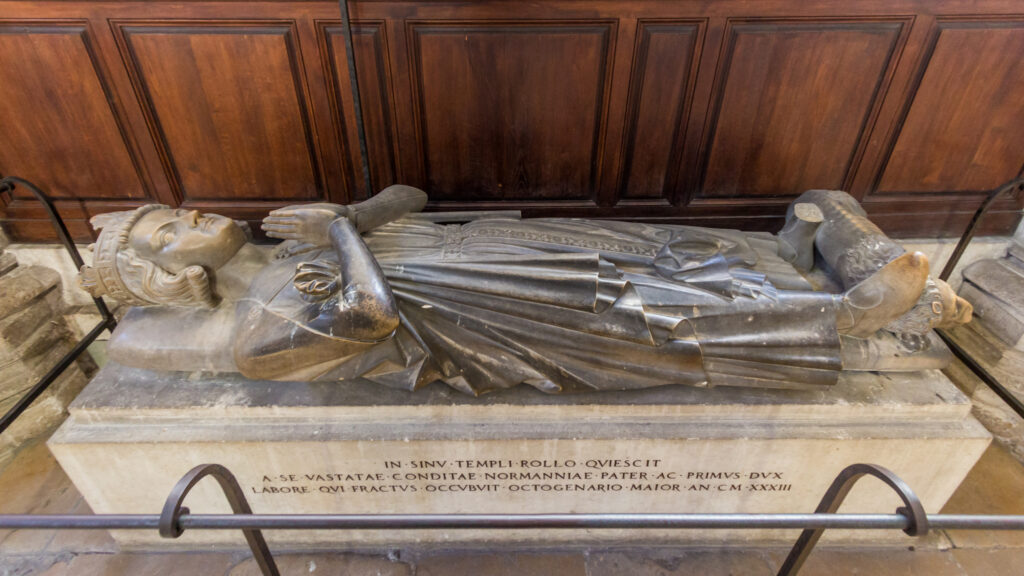
In 886 CE a Danish giant named Hrólfr (aka Rollo) led a raiding party, reputedly of over one hundred ships, up the River Seine, and declared war on the Franks, besieging Paris and laying waste to the adjacent territory. Delivering medieval blitzkrieg from their versatile long-ships created havoc. The King of the Western Franks, Charles the Simple sued for peace and offered Hrólfr a large tract of land in Neustria in 911 CE. Charles required Viking fealty, conversion to Christianity and the active discouragement of similarly belligerent Norsemen from their new homeland. This area of land became known as Normandy, the literal Frankish translation of ‘north man’s land’.
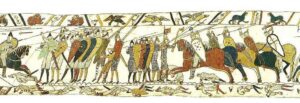
Just over one hundred and fifty years later Hrólfr’s great, great grandson William the Conqueror and his army of Viking descendants faced the Saxons in a battle for England. The tactics, equipment and even language of the Conqueror’s army would probably have been unrecognisable by his Viking ancestor. Just how did the Norsemen metamorphosis so completely into Normans within six generations?
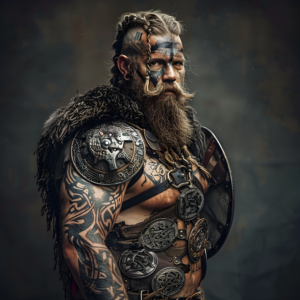
Viking conversion to Christianity was not some Damascene moment on landing in Normandy; in fact, their pagan-based belief system already catered for the inclusion of new gods. Christianity had hitherto been forcibly encouraged in Scandinavia by zealous monarchs like Haakon Sigurdsson and Olaf Trygvasson offering a simple choice of convert or die. When Hrólfr’s Vikings raided Frankia they were not the oft-depicted pagan crusaders preying on churches and monasteries, yet they were polytheistic raiders who fought only for wealth and reputation. The Vikings’ ideology and worldview did not change after Hrólfr made his questionable religious vows. Christianity took many years to become embedded in the hearts and minds of the devout Normans they evolved into.
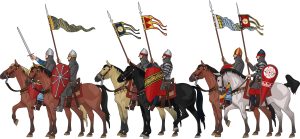
 The newcomers now fought in defence of their homeland on land, no longer needing to travel vast distances by water in search of fresh victims. As a result, the Vikings forgot the revered shipbuilding skills of their ancestors and the horse replaced the long-ship as their main weapon of war. From their Frankish neighbours, they adopted the war horse (destrier) to carry them into battle and developed sophisticated skills and tactics. A strict military culture evolved and was the key to developing a successful war machine. Boys were schooled from as young as six years old to fight as part of horse-borne companies (conroi), charging in lines of up to twenty men at full pelt on massive armoured stallions. Redolent of a squadron of modern-day tanks, they rode into battle with state-of-the-art arms and armour. Victories over King Henri of France at Varaville in 1057 CE and the defeat of a vast Papal army at Civitate the following year confirmed Norman military dominance in Europe.
Eight years later the Conqueror’s army defeated King Harald’s exhausted defenders, with their vanguard of Norse mercenaries (huscarls), at the Battle of Hastings. This was only a week after the Saxons had destroyed a large army of Norwegian Vikings two hundred miles away. These cataclysmic events were disastrous for the losing sides and heralded the end of the Vikings’ golden age.
Clearly, Hrólfr’s Vikings did not become Normans overnight, instead the conversion took many generations. When the predominantly male company settled in Normandy in 911 they represented approximately 8% of the local population. Genetic necessity paired them off with local women and over time, assimilated with the local Frankish and Gallo-Roman populations producing hybrid offspring and adopting elements of language, culture, and customs.
Ultimately they were opportunists. Although they were few in number they took their chances and prospered by exploiting all the new resources at their disposal. There were never going to be enough Vikings to retain a single Norse identity but they still became the dominant force in the new melting pot. They adopted the best elements of Frankish military prowess and melded it with an innately fierce warrior spirit. The settlers took their pick of the local women and planted their roots deep in Norman soil. The Hvítakristr, the white-Christ, once just another deity in the Norse firmament became, aided by Rome’s lucrative promotion, a driving spiritual force. The indomitable fighting élan that originally won them Neustria shone brightly through Norman eyes long after the setting of the Viking sun.