I always wondered whether King Harold’s forced march from Stamford bridge actually happened as conventional history tells us but now compelling new evidence has suggested otherwise. The historical consensus for the “exhausted march” rested almost entirely on a single phrase in the Anglo-Saxon Chronicle. It claimed Harold’s fleet “came home” just before the Viking invasion, leading generations of historians to assume the entire navy was disbanded and the men were scattered.
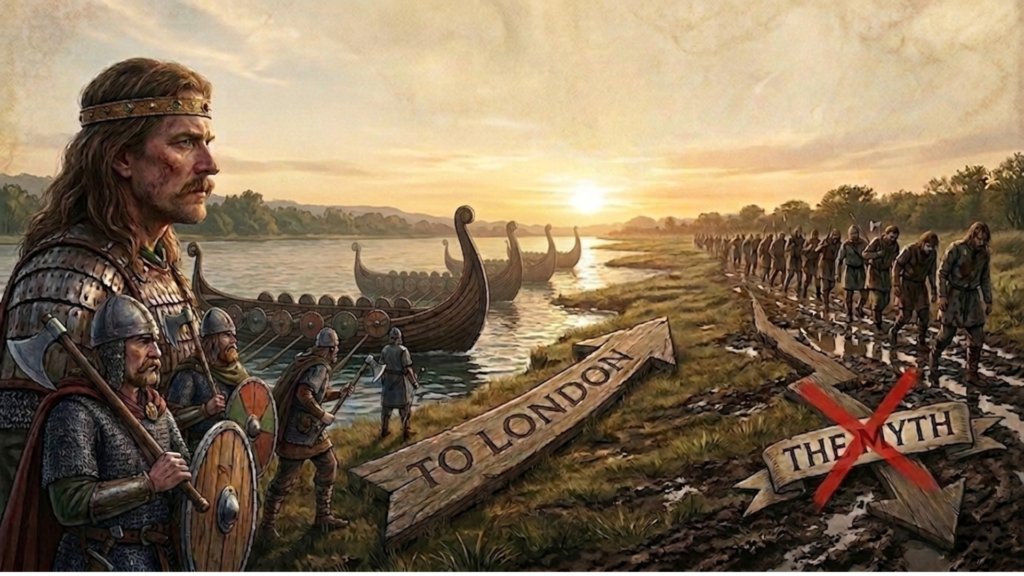
For nearly a millennium, the story of King Harold Godwinson’s final campaign has been framed as a tragic, superhuman slog. History books have long insisted that after crushing the Vikings at Stamford Bridge in Yorkshire, Harold led his weary army on a brutal, 190-mile “forced march” to the south coast, arriving at Senlac Hill exhausted and ready to be picked off by William the Conqueror. However, according to explosive new research released in March 2026, this iconic image of a “mad dash” through the mud might be nothing more than a Victorian misunderstanding.
- The “Home” Truth: A Linguistic Breakthrough
The traditional narrative of a foot-weary army hinges on a single, pivotal phrase in the Anglo-Saxon Chronicle stating that Harold’s fleet “came home” just before the Viking invasion. For centuries, historians assumed this meant Harold had disbanded his navy and sent his sailors back to their farms, leaving him with no choice but to walk. Professor Tom Licence of the University of East Anglia has recently turned this theory on its head. By re-examining contemporary linguistic nuances, Licence argues that the Old English word used for “home” (ham) did not signify a dismissal of the troops. Instead, it referred specifically to the fleet’s permanent naval base in London. Far from being gone, the navy was staged, supplied, and waiting for the King’s command.
- Three Possible Scenarios: How Did Harold Really Get South?
With the 2026 evidence in hand, we now have three distinct possibilities for how the English army covered nearly 200 miles in less than two weeks:
- The Traditional View: 190 miles via Ermine Street would have delivered an exhausted depleted army
- The Mounted Dash: Elite troops arriving fast, the rest arriving late
- The Naval Shortcut: Fresh, rested and ready for battle.
- The “Most Likely” Outcome: The Land-Sea Operation
Rather than a desperate sprint, the evidence suggests Harold was a far more sophisticated strategist than previously believed. Instead of subjecting his veterans to a grueling march that would leave them unfit for combat, he likely executed a high-stakes, multi-modal operation.
- Preserving the Elite
By using his intact fleet to transport his veteran Housecarls from the Humber Estuary down to London, Harold ensured his most lethal fighters were not crippled by a 200-mile walk. This allowed the core of his army to remain “fresh” for the inevitable clash with the Normans.
- A Coordinated Pincer Move
New research suggests Harold didn’t just plan to meet William on a ridge; he intended to trap him. Harold appears to have used his ships to establish a maritime blockade, intending to trap the Norman fleet at sea while his land forces pinned them against the coast.
- The Bosham Evidence
Perhaps the most “real-world” proof comes from recent LIDAR surveys and excavations conducted in Bosham. These surveys uncovered Harold’s private maritime infrastructure—massive dry docks and logistics centres that confirm he had the capacity for lightning-fast troop transfers.
- Why This Rewrites Everything
If Harold’s army arrived at Senlac Hill rested—transported by ship and horse rather than trudging through the mud—the entire context of the Battle of Hastings changes. It suggests the English didn’t lose because they were “too tired”. On the contrary, they were a fresh, well-coordinated, and tactically sound force.
The loss was likely due to the tactical innovation of the Norman cavalry or a stroke of pure, devastating bad luck—not a lack of preparation. The “forced march” was a romanticized myth created to explain away a crushing defeat. The reality was a logistical masterclass that, with a little more luck, very nearly saved Anglo-Saxon England.