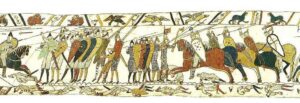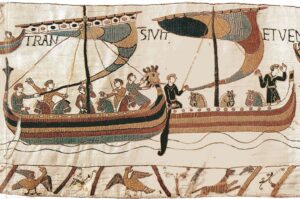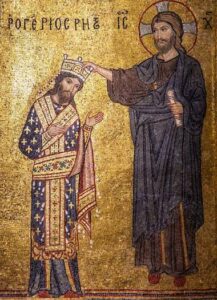

Whether William the Conqueror was a brilliant strategist or just a lucky general has been a matter of conjecture, depending on whose side you were on. However, no one could ever accuse him of prevarication as he demonstrated following the Battle of Senlac Hill (1066) or Hastings, as it became better known in later centuries. What is incontrovertible is that he undertook a rapid, calculated series of military and political actions immediately following his victory to solidify control over the kingdom, culminating with his coronation at Christmas of the same year.
The first thing he did was move his forces, marching and ravaging along the south coast. This was not wanton destruction but a calculated campaign to subdue the south-east of England and isolate a well-defended London. In the immediate aftermath of battle, he rested and tended to the wounded near Hastings. As soon as they were ready, he marched along the coast, arriving at Romney and burning down the town, giving a signal to any would-be rebels of the consequence of defiance. He then moved swiftly to Dover, a strategic Saxon stronghold and the narrowest point between England and Normandy and took it without resistance. For good measure, he plundered and torched the nearby town, which he then refortified and garrisoned to protect the Norman rear as they moved inland toward London.
William was wary of the fortress of London and, rather than risk a direct attack, chose to send a small force of cavalry to Southwark to secure the southern end of London Bridge, the critical crossing point of the River Thames. This was met with resistance by the locals, who the Normans defeated, but they were unable to hold the bridge in the fierce fighting. William withdrew from Southwark but set the town ablaze, sending a powerful message to the Capital’s inhabitants and spreading terror among the onlookers across the river. Almost the entire town, including the Royal Mint, was destroyed, and London appeared isolated.
After the strong defence at Southwark, William postponed a direct assault on London, moving in a circuitous march around the city. He then moved south-east, taking Winchester, the former seat of English government and royal treasury, where he left a strong garrison. With the remainder of his troops, he returned close to the capital and crossed the Thames at Wallingford. This effective encirclement was a warning to the inhabitants of London and an indication of the severe consequences of continued resistance. William continued his rampage, ravaging the lands between Bedford and Hertford and torching towns and murdering citizens.
By early December, his actions—cutting off supply routes and using terror—forced the Anglo-Saxon leadership to act. The English nobility, including the Witenagemot, the Archbishops, and the elected but uncrowned king, Edgar Ætheling, surrendered at Berkhamstead in Hertfordshire. They swore fealty and pledged their allegiance and, importantly, delivered the keys to the city gates to William. As a contest, it was all over.
The Duke of Normandy was determined to crush the life out of any further resistance perceived or otherwise and immediately ordered that fortifications be built to ensure control over the capital and subdue the hostile Londoners. Three new castles began to be constructed, including what would become the imposing White Tower of London.
Soon it would be Christmas, and Duke William was crowned King of England at Westminster Abbey on Christmas Day, 25 December 1066. In a hurried affair, both sides were keen to end the political limbo. The Normans needed the rewards promised from the conquest, which could only be distributed once William was officially king. In a ceremony at Westminster Abbey, founded by the Duke’s predecessor, Edward the Confessor, the Duke became a King. Ealdred, the Archbishop of York, conducted the ceremony because Stigand, in an action which did not further his career, the Archbishop of Canterbury, refused to crown William, stating he was “covered with the blood of men.” During the service, when the English and Norman nobles shouted the traditional acclamation and approval, Norman soldiers outside the abbey misinterpreted the noise as a riot or assassination attempt. In a desperate move, they set fire to the surrounding houses. The building filled with smoke, and the congregation evacuated in terror, leaving William and a few of his diehards to complete the ceremony. Despite the chaos, he steadfastly completed the rite, but the debacle took its toll, and he became ill shortly afterwards. But he had completed the coronation and took the traditional Anglo-Saxon coronation oath, adding a solemn promise that he would rule the English people as well as the best of their previous kings had done.
Historians have judged William the Conqueror harshly, but his immediate actions (following the battle of Hastings)—the deliberate devastation of the surrounding countryside and fortified towns, the strategic encirclement of London, and the rapid, though chaotic, establishment of legitimacy through the Christmas Day coronation—were critical milestones which enabled him to turn military victory into political control in 1066.
Think of the Anglo-Saxon resistance as a fortified city, and think of William’s immediate actions as a siege. First, he attacked, ravaged and burned the surrounding suburbs (Southwark, Romney, Dover), spreading terror and destroying forward defences. By subsequently cutting off all supply lines and escape routes (laying waste to the area between Bedford and Hertford, he took Wallingford), forcing the city’s leaders to surrender before he could enter and claim his throne. After the Battle of Hastings, he moved decisively and without prevarication to secure his goals, and he should be recognised for that. The world’s most successful generals – think Alexander the Great, Genghis Khan, Napoleon Bonaparte – were men of action and arguably great risk-takers who ignored the resulting suffering to the local population. William the Conqueror definitely fitted that description.