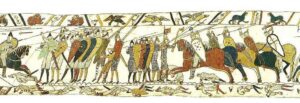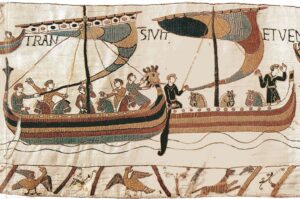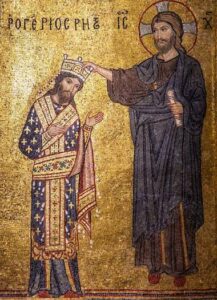

During 1066 the belligerent war leaders of Harold Godwinson, Harald Hardrada, and William of Normandy met on various fields of battle in England. They all believed that they had a right to the English throne and each man used fair means and foul to attempt to achieve his aim. Were they “evil men” or merely” opportunists? This is a highly subjective question and depends on the perspective from which one examines their motivations and subsequent actions. It is also worth looking at each protagonist within the context of the “Year of Three Battles of 1066” before any objective judgment can be made. At stake was the bejewelled prize of England for which thousands of people, local and foreign, gave their lives. In this pivotal year, in which there was only one winner we look at each claimant’s bonafides.
Harold Godwinson: aka the last Anglo-Saxon king of England, Harold’s reign was marked by a plethora of challenges, including invasions from both King Harald Sigurdson (aka Hardrada) and Duke William of Normandy (aka the Bastard, the Conqueror). He is often seen as a nationalist and a hero for defending England against foreign invaders, particularly in the Battles of Fulford and Stamford Bridge against the Norwegian invaders and their allies. Some might, justifiably, argue that he was an opportunist, having claimed the throne following the deathbed blessing of Edward the Confessor and despite protests from other claimants. His actions can be viewed in both lights, depending on one’s interpretation of loyalty, kingship, and the legitimacy of power in 11th-century England. We rate him a clear opportunist.
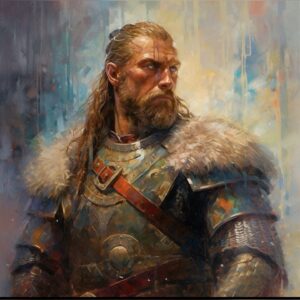 Harald Hardrada: The King of Norway was an ambitious and belligerent leader looking to expand his influence and reclaim the land he believed was rightfully his. His invasion in the north of England was an attempt to assert his claim to the throne, which he thought was supported by a previous agreement with Edward the Confessor and his bloodline to Cnut the Great. Hardrada can be seen as an opportunist, taking advantage of perceived weaknesses in England’s leadership. However, within the context of the period, his actions were not out of the ordinary, as conquest and expansion were common among rulers. He was a clear opportunist, but with good reason, although his previous service for the Byzantine empire, included plenty of evil-doing.
William, Duke of Normandy (William the Conqueror): William’s claim to the English throne was based on a promise made to him by Edward the Confessor, and a pledge of fealty from Harold Godwinson, who had sworn an oath of loyalty to William. His invasion in 1066 was a risky move to claim what he believed was his rightful inheritance. William is often viewed as an opportunist, with an evangelist’s zeal, taking advantage of the political turmoil in England to fulfil his ambitions. His success also led to irreversible and significant changes in England, including establishing Norman rule, culture, language and religion. His barons and allies also enriched themselves, relieving the Saxon earls of the vast majority of their land and wealth. We rate the Bastard as the ultimate opportunist and risk-taker although not intrinsically evil.
In summary, calling these protagonists, either “evil” or “opportunistic”, oversimplifies their motivations particularly when viewed within the historical context of their actions. Each can be viewed as acting within the norms and expectations of their time, driven by a mix of ambition, loyalty, and the harsh realities of medieval power dynamics. Their legacies are complex, although William was the last man left standing and, as we know, history is written by the winner. They were all ambitious and (probably) felt compelled by repetitional pressure, as much as avarice, to do what they did. Either way 1066 was the year of three defining battles for all of them which none of the would-be English kings could afford to lose