
Two Opposing Medieval Queens, Two Differing Fates
In the year 1066, the fate of England was not decided solely by the clash of steel at Hastings, but by the influence and pedigree of the women standing behind the rival claimants.
Nothing exemplifies this transition better than the comparison between Edith Swanneck (Edith the Fair), the handfasted partner of Harold Godwinson, and Matilda of Flanders, the royal-blooded wife of William the Conqueror. Their strengths and weaknesses mirror the cultures they represented: one a symbol of the wealthy, integrated Anglo-Danish landscape, the other a powerhouse of continental diplomacy and Catholic legitimacy.

Matilda of Flanders: The Architect of Legitimacy
Matilda was far more than a consort; she was the spiritual and diplomatic engine of the Norman Conquest. Her lineage was her greatest weapon, as she was a direct descendant of King Alfred the Great and the granddaughter of the King of France.
Strengths
- Royal Pedigree: Her descent from Alfred the Great provided William with a vital genealogical link to the English throne, helping to “legalise” his claim in a world obsessed with bloodlines.
- Diplomatic Mastery: When the Church initially banned her marriage to William due to consanguinity, Matilda spearheaded a “Great Penance.” She founded the Abbaye aux Dames in Caen, transforming a scandal into a massive display of piety that eventually secured the Pope’s blessing.
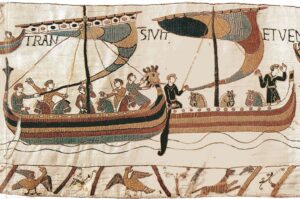
- Logistical Power: Matilda was the primary patron of the Mora, the flagship of the invasion fleet. By financing and overseeing the construction of the ship that carried William to England, she proved herself a strategist of the highest order.
- Administrative Grit: While William fought in England, Matilda served as the Duchess-Regent in Normandy. She held the duchy together with a steady hand, ensuring the “Leopard’s” home was secure while he hunted across the channel.
Weaknesses
- Foreign Perception: To the English, Matilda was a “foreigner.” Her power was rooted in stone and papal decree rather than local land-based loyalty.
- The Consanguinity Shadow: The early years of her marriage were plagued by legal challenges from Rome, a vulnerability that her enemies exploited to question the legitimacy of her heirs.

Edith Swanneck: The Heart of the Danelaw
If Matilda represented the “New Order” of Europe, Edith Swanneck represented the “Old Norse” traditions that still pulsed through the heart of England. As Harold Godwinson’s partner more danico (in the Danish fashion), she was a symbol of the integrated Anglo-Scandinavian world.
Strengths
- Vast Wealth: Edith was one of the wealthiest landowners in England, particularly in East Anglia. Her holdings near places like Maldon gave her immense local influence and the resources to fund Harold’s fyrd.
- Cultural Connection: Unlike the Norman-style “Christian” legitimacy of Matilda, Edith’s handfasted status resonated with the Danish-settled regions of England. She was a figurehead for the people of the Danelaw who still valued Viking-age customs.
- Indomitable Loyalty: Her strength was emotional and symbolic. History remembers her most for her grim task after the Battle of Hastings: identifying Harold’s mangled body by “marks known only to her” when no one else could recognize the King.
Weaknesses
- Legal Insecurity: Because her marriage was more danico, the Church viewed her children as illegitimate. This was a fatal political weakness when compared to Matilda’s papally-sanctioned union.
- Political Isolation: Edith had no powerful continental relatives to call upon. When the invasion began, she was reliant entirely on the strength of the English shield wall – which alas failed both her and England.
The Verdict: Legitimacy vs. Legacy
The struggle between these two women was a conflict between the old vs the new.
Matilda built her power in stone—the great abbeys of Caen and the castles of the Normans. She focused on the future, securing the Pope’s favor and ensuring her sons would rule as “ordained” kings. Her weakness was her distance from the English heart, but her strength in diplomacy eventually made the Norman world indomitable.
Edith Swanneck was rooted in the soil of England. Her strength was her connection to the land and the old traditions of the Northmen who had settled there generations before. However, her weakness was her lack of “official” standing in a rapidly modernising, Church-dominated Europe.
“While Edith represented the fading embers of the Viking age in England, Matilda was the rising sun of the Norman era. One identifies the fallen; the other builds for the survivors.”
Matilda won the crown, but Edith arguably held the heart of the kingdom.