William Marshal: Norman Throwback or Prototype English Knight?
When Archbishop Stephen Langton stood over the lifeless body of William Marshal in 1219, he famously pronounced him “the greatest knight that ever lived.” To contemporary observers, Marshal was the very mirror of chivalry—a paragon of loyalty, piety, and unmatched martial prowess. Yet beneath the glittering armour of his later legendary status lay a more complex historical reality. Was William Marshal merely a throwback to the brutal, opportunistic Norman warlords who crossed the Channel with the Conqueror, or was he the true prototype of the idealised English knight, representing a new, institutionalised era of chivalry? To answer this, one must travel back to the rain-swept borderlands of twelfth-century Normandy, where a penniless fourth son was hammered into a legend.
The Crucible of Tancarville: The Norman Roots
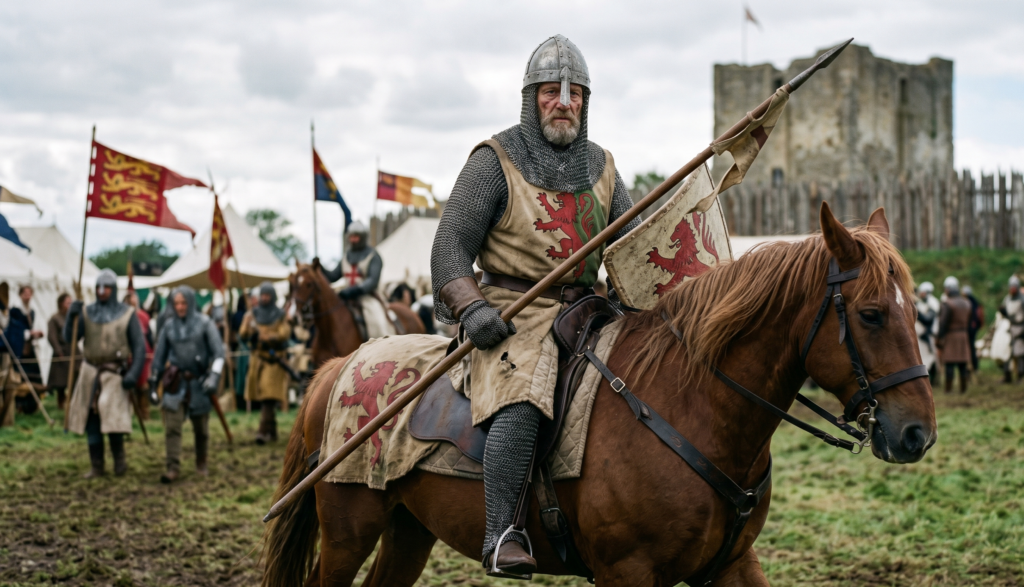
William’s journey did not begin in a grand court, but in the brutal reality of a political hostage situation during the English Anarchy. Having survived his father John Marshal’s famously callous disregard—John famously declared he still possessed the “hammers and anvils to forge finer sons” when King Stephen threatened to hang young William—the boy was sent across the Channel around 1152. His destination was the household of his mother’s cousin, William de Tancarville, the hereditary Chamber of Normandy.
At the castle of Tancarville, situated prominently near the mouth of the Seine, William entered a world that was thoroughly and uncompromisingly Norman. This was the traditional incubator of the cnith (squire). His earliest training was less about romantic ideals of courtly love and entirely about the grinding, physical reality of survival and violence. For over a decade, Marshal endured a grueling regime designed to weaponise the human body.
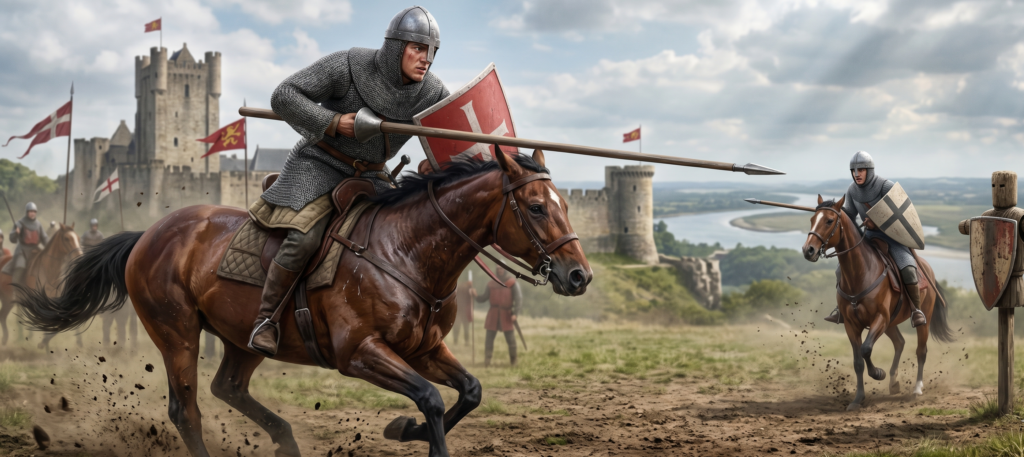
He learned to wear heavy chainmail (hauberk) for hours without faltering, treating it as a second skin. He mastered the art of the couch-lance technique, a relatively recent military innovation that transformed a horse and rider into a single, devastating projectile. This required immense core strength, flawless equestrian skills, and absolute synchronisation with a powerful destrier. Hours were spent striking the quintain—a rotating target that would swing around and strike the squire in the back if he was too slow. In this highly competitive, hyper-masculine environment, Marshal earned the nickname Gaste-Viande (Waster-of-Meat or Accursed Glutton), a testament to both his teenage appetite and a towering physical frame that required substantial fueling.
“The young squire learned that a knight’s primary duty was not to write poetry, but to sustain blows that would shatter lesser men, and to return them with calculated, lethal precision.” — The History of William Marshal
The Driving Forces: A Landless Man’s Ambition
What drove the young Marshal to endure this grueling apprenticeship? The answer is simple and stark: landlessness. As a fourth son, William inherited no estates, no titles, and no revenue. In the Anglo-Norman world, a young man of noble blood without land occupied a precarious position. He was a iuvenis—a youth, a classification that denoted social status rather than age. Until a knight acquired land through royal favor or marriage, he remained a perpetual youth, a military mercenary bound to the households of wealthier lords.
Therefore, the primary driving force behind Marshal’s early career was economic survival, fueled by an intense desire for social advancement. Prowess (proece) was not just a moral virtue; it was his currency. In the Norman tradition, warfare was an entrepreneurial venture, and the newly knighted William (dubbed in 1166) quickly found his true calling on the international tournament circuit of northern France.
Twelfth-century tournaments were not the polite, highly choreographed jousts of the late Middle Ages. They were massive, chaotic mock-battles (mêlées) fought across miles of open countryside, encompassing fields, villages, and woods. The rules were minimal, and the primary objective was practical: capture opposing knights, seize their horses and armour, and hold them for ransom. Here, the “Norman throwback” elements of Marshal’s character shone brightly. He possessed a shrewd, business-like approach to combat. Alongside his frequent tournament partner, Roger de Gaugi, Marshal kept meticulous mental ledgers of their captures. Over his lifetime, he is recorded to have captured over 500 knights. This was high-stakes corporate raiding in chainmail.
The Metamorphosis into the Prototype English Knight
If William Marshal had remained merely a successful tournament athlete, history would remember him as a minor, mercenary figure—a brilliant relic of the predatory Norman warrior caste. However, the true genius of Marshal’s story lies in how he sublimated this raw Norman martial energy into the blueprint for the prototype English knight.
The turning point came through his transition from the tournament fields to royal service under the Plantagenets. Entrusted with the tutelage of the Young King Henry, and later serving Henry II, Richard the Lionheart, John, and Henry III, Marshal encountered the evolving concept of courtoisie (courtesy) and institutional loyalty. The prototype English knight needed to be more than a killer; he needed to be a statesman, a loyal servant to the Crown, and a legal pillar of the realm.
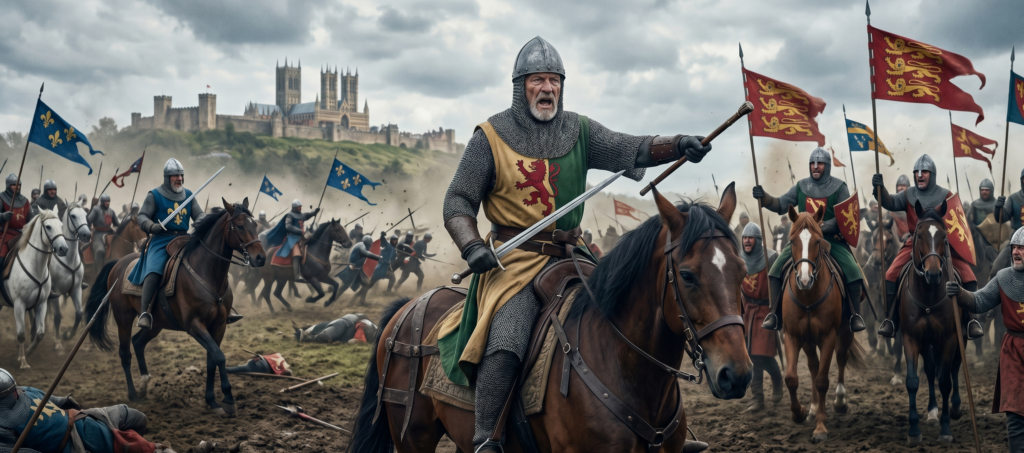
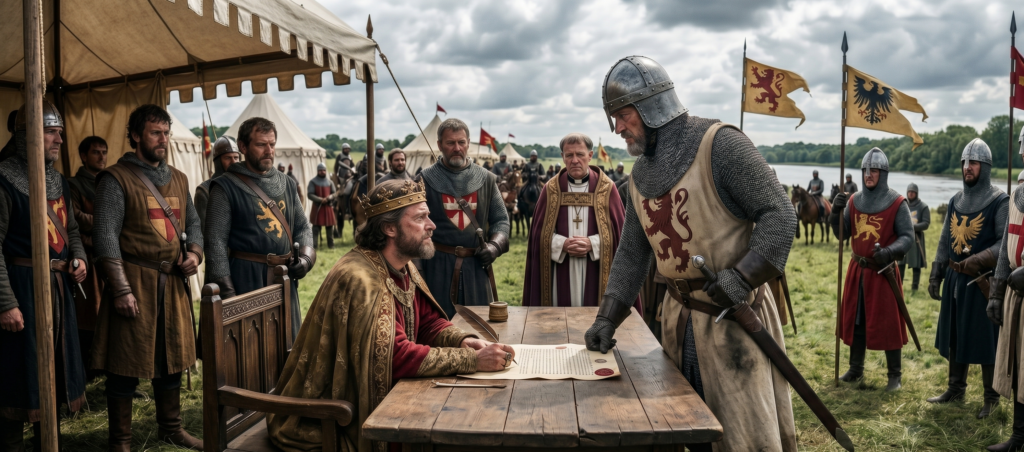
Marshal successfully bridged these two worlds. His absolute loyalty to the Crown—even when serving a disastrous monarch like King John—became his defining trait. He demonstrated that the ultimate honor for a knight lay in keeping his word (foi). When England faced a French invasion and a civil war in 1216, it was the aging Marshal, now Regent of England, who rallied the barons, defeated the French at the Battle of Lincoln, and reissued Magna Carta. He took the violent energy of his Norman forebears and harnessed it to preserve the fabric of the English state.
Conclusion: A Bridge Across Eras
Ultimately, William Marshal cannot be neatly categorised as either a Norman throwback or an English prototype; he was the vital evolutionary bridge between them. His earliest training at Tancarville imbued him with the ruthless pragmatism, physical stamina, and opportunistic drive of the Norman conquerors. He knew the value of a horse, the price of a ransom, and the lethal efficiency of a lance shock-charge.
Yet, by wedding this ferocious Norman prowess to an unshakeable concept of feudal loyalty and royal service, he helped define what the English knight would become for centuries to follow. He transformed knighthood from a devastating trade of landless warriors into an honorable, institutionalised vocation of statecraft and chivalry, securing his place not just as England’s greatest knight, but as its foundational one.